)
Running a busy clinic with a growing caseload? The software stack holding your operations together has a direct impact on how efficiently your team works and how accurately your records reflect what happens in the exam room.
Moving that stack to cloud-based tools means your team can access records and manage operations from any device, without relying on on-site servers or manual syncing across locations.
Cloud-based veterinary software covers several distinct categories, and the tools that handle scheduling and billing are doing something fundamentally different from the ones that capture clinical notes. For practice managers evaluating options, the most useful starting point is understanding which category solves which problem.
Cloud-based veterinary software categories for 2026
Having cloud-based tools across all four veterinary management software categories means your stack is accessible from any device, easier to manage across locations, and less dependent on on-site infrastructure. A well-functioning stack typically covers:
Practice management systems (PMS): The operational backbone of a clinic. Handles patient records, scheduling, billing, invoicing, and inventory in one centralized system.
Appointment scheduling and client communication tools: Automate booking, reminders, follow-ups, and two-way client messaging to reduce front desk load and keep clients informed between visits.
Billing and inventory management tools: Track financial performance, manage stock, and automate reordering. Often built into a PMS but available as standalone tools for practices that need more depth in either area.
AI documentation and scribing tools: Capture what happens during the appointment itself, converting spoken clinical notes into structured medical records in real time or immediately after the consultation.
Gaps in any layer affect how accurately the others reflect what actually happened during the visit. When evaluating tools across any of these categories, a December 2025 AAHA Trends article identifies six criteria practice decision-makers consistently return to:
Ease of use
Customization and flexibility
Integration with other systems
Mobile accessibility
Customer support quality
Pricing structure
They're worth applying to every tool you shortlist, not just the ones covered here.
Practice management systems
According to the AVMA's 2025 economic report, adopting new technologies and removing process inefficiencies are the primary levers for improving practice productivity.
A PMS is typically where that starts. It manages the day-to-day infrastructure of a clinic — patient records, scheduling, invoicing, billing, and inventory — in one place. For a practice running four vets across two locations, or a single-doctor clinic with a growing caseload, that centralization is what keeps operations from fragmenting across spreadsheets, whiteboards, and end-of-day catch-up sessions. The electronic medical records in veterinary practice layer sits within it, housing each patient's clinical history, diagnoses, and treatment documentation.
Top options and who they suit
Tool | Best for | Standout feature |
IDEXX Neo | Small to mid-sized practices | Native IDEXX lab integration |
ezyVet | Mid-to-large and specialty practices | Deep customization and reporting |
Shepherd | Mobile-first, modern clinics | Built by veterinarians, integrated payments |
IDEXX Neo is built for small to mid-sized companion-animal practices. The interface is straightforward, and onboarding is fast relative to larger platforms. Native IDEXX diagnostics integration means lab results flow directly into the patient record without manual handling. Choose IDEXX Neo if your practice runs on IDEXX diagnostics and ease of use is the priority.
ezyVet suits mid-to-large practices and specialty hospitals that need maximum configurability. It offers wide third-party integrations, detailed reporting, and strong multi-location support. Choose ezyVet if your practice needs deep customization and cross-location reporting, and has the onboarding capacity to get the most out of a feature-rich platform.
Shepherd is a mobile-first PMS built by veterinarians, with integrated payments and an interface designed around how clinic teams actually move through a day. Choose Shepherd if you want a modern, intuitive PMS with fast onboarding and a workflow-first design.
What practice management systems don't cover
A PMS manages the infrastructure around a visit, not what happens during it. Clinical findings, treatment rationale, and the reasoning behind diagnostic decisions are documented separately, usually after the appointment. For most teams, that means charting happens later in the day, from memory, when the detail is harder to recover. Closing that gap is a key part of optimizing veterinary efficiency.
Appointment scheduling and client communication
Scheduling and communication tools are built to reduce phone volume, automate appointment reminders, and keep two-way messaging with clients running without manual effort from your front desk. They handle the communication around a visit — confirming appointments, sending reminders beforehand, and following up afterward — so your team spends less time on inbound and outbound calls.
Top options and who they suit
Tool | Best for | Standout feature |
Chckvet | All-in-one client engagement | Real-time online booking with PIMS write-back, AI-triaged two-way messaging, reminders, reviews, and loyalty in one platform |
Vetstoria | Reducing front desk scheduling load | Real-time PMS sync and online booking with payment collection |
Chckvet brings booking, messaging, reminders, reviews, loyalty, and practice analytics under one roof, with AI that screens and triages incoming messages by topic and urgency. It's an AAHA Preferred Business Provider and writes back to PIMS like AVImark, EzyVet, ImproMed, Provet Cloud, Pulse, Rhapsody, and Shepherd. Choose Chckvet if you want a single platform covering the full client journey — not just the schedule.
Vetstoria focuses on online booking with real-time PMS sync and payment collection to reduce inbound calls. Choose Vetstoria if your primary need is cutting front desk scheduling volume.
What scheduling and communication tools don't cover
These tools manage the relationship around the visit, not the record of what happened during it. Client communication is only as accurate as the clinical notes it draws from. If those notes are written hours later from memory, the details that matter — treatment rationale, follow-up instructions, medication changes — may not make it through to what the client actually receives.
Billing and inventory management
These tools track financial performance, manage stock levels, and automate reordering to keep charge capture and supply management running alongside clinical operations. For most practices, this functionality is built into their PMS. Where practices need more depth — high inventory volume, controlled substance tracking, or multi-location stock management — standalone tools such as Inventory Ally can fill that gap. However well any of these systems work, they can only bill for what the clinical record says happened.
What billing and inventory tools typically cover
PMS platforms vary in how deeply they handle billing and inventory. Some offer robust charge capture and automated reordering, others cover the basics and no more. For practices whose PMS handles the necessary tasks adequately, adding a standalone tool introduces another integration point without much to show for it.
What billing and inventory tools don't cover
A procedure that isn't captured in the note at the time of the visit is difficult to recover later. If missed charges are a recurring issue in your practice, the documentation workflow is worth examining before assuming the billing tool is the problem.
AI documentation and scribing
AI documentation tools work at the clinical moment itself. They capture spoken notes during or immediately after the consultation and convert them into structured medical records, without the detail having to survive until the end of a full appointment schedule.
For clinics where administrative workload has become a pressure point, this category is worth a close look. A 2025 FVE survey of 75 veterinarians found that 64% reported their administrative workload had more than doubled in recent years, with none reporting a decrease. That time carries a financial cost, too. The AVMA's 2025 economic report puts gross revenue per veterinarian at an average of $288 per hour in 2024, with inflation-adjusted productivity declining since 2020. Time spent on documentation is time not spent with patients, and at $288 per hour, those hours have a direct cost to practice revenue.
H3: What AI documentation and scribing tools do
AI veterinary scribe tools differ from basic dictation software in one important way. They apply veterinary-specific structure to spoken input automatically, formatting clinical findings, differentials, treatment decisions, and recommendations into a complete SOAP note rather than a raw transcript. AI's role in veterinary medicine is still evolving, but at the documentation layer, the core function is well-established. Capture what happened during the visit, structure it correctly, and get it into the record without a manual step in between.
When evaluating tools in this category, these criteria are worth checking across every option you consider:
Veterinary-specific templates — does the tool support the species, specialties, and case types your team sees day to day?
Offline capability — can it function without an internet connection, for mobile, rural, or field practice?
PMS integration depth — does the note write directly into the patient record, or does it export text that still needs to be placed manually?
Input language support — does it support the languages your clinical team works in?
Data privacy — is patient data used to train AI models, and what compliance standards does the tool meet?
SOAP note automation software varies significantly on each of these. The differences affect daily workflow more than most feature comparisons suggest. For a broader look at how documentation tools fit into clinic operations, see our guides to optimizing veterinary efficiency and innovative vet apps.
CoVet
Tool | Best for | Standout feature |
CoVet | DVMs, RVTs, and practice managers looking to close the point-of-care documentation gap | Scribe, visit summarization, task management, and direct PMS transfer in one tool |
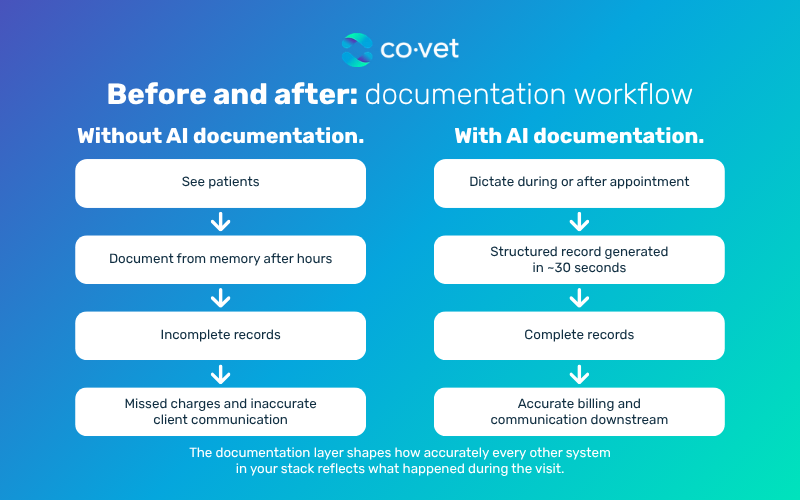
CoVet's unique approach to veterinary medicine sits in the AI documentation category as a dictation-based AI veterinary scribe — capturing clinical reasoning during or after the consultation and structuring it into a complete SOAP note in ~30 seconds. It handles visit summarization, task management, and direct PMS transfer, sitting alongside your existing stack rather than replacing any part of it.
Choose CoVet if your DVMs are finishing notes after hours, clinical detail is getting lost between the exam room and the record, or your current documentation workflow is creating downstream problems with billing accuracy or client communication. It doesn't manage scheduling, billing, inventory, or client communication — those layers need their own tools.
“CoVet has increased the speed and details of my medical records! The more I use it, the quicker I get! I clocked out of work at 6:05 last night and had appointments up until 5:40! That never happens!" — Rachel Hill, DVM, Trustpilot review, August 2025 |
What a complete veterinary software stack looks like in 2026
An effective vet clinic software stack covers four categories — practice management, scheduling and client communication, billing and inventory, and AI documentation. Cloud-based tools across all four mean your stack is accessible from any device, manageable without heavy IT overhead, and easier to keep consistent across locations and shifts. For many practices, moving to cloud-based tools across these categories can help reduce operational friction and support more efficient use of clinical time — both of which tend to have a measurable impact on productivity and revenue.
The first three categories handle the infrastructure around the appointment. The documentation layer determines how accurately all of them reflect what happened during it. CoVet sits in that fourth layer — capturing clinical reasoning by dictation during or after the consultation, structuring it into a complete SOAP note in ~30 seconds, and transferring it directly into your existing PMS via PMS integration. It works alongside practical veterinary practice management tools, not instead of them. When clinical reasoning is captured at the point of care — and that record syncs directly into a cloud-based PMS — billing, client communication, and handoffs to colleagues all draw from what actually happened in the room.
Frequently asked questions about cloud-based veterinary software
Can I use cloud-based software across multiple clinic locations?
Yes, multi-location access is one of the main practical advantages of cloud-based tools over server-based alternatives. Because data is hosted by the vendor rather than on-site, your team can log in from any location with an internet connection, and records can stay more consistent across sites without manual syncing. When evaluating tools, check whether pricing and user management scale to your number of locations, and whether reporting can be segmented by site.
Can cloud-based veterinary software work without an internet connection?
It depends on the tool. Most cloud-based platforms require an active connection to function. Some, including CoVet, offer an offline mode — useful for mobile, rural, or large animal practice. If your work takes you into low-connectivity environments, offline capability is worth verifying before committing.
How long does it take to implement a new cloud-based veterinary PMS?
Implementation timelines vary by platform and practice size. Some systems can be operational within a few weeks for a single-location practice. Migrating from a legacy server-based system typically takes longer, with data migration adding the most complexity. The onboarding experience differs considerably between platforms, so support quality is worth factoring into your evaluation.
Is cloud-based veterinary software secure enough to store patient records?
For compliant platforms, yes. Look for tools that meet HIPAA (US) and PIPEDA (Canada) requirements, with end-to-end encryption, audit trails, and SOC 2 certification. Review data ownership terms carefully, particularly where patient data sits on vendor infrastructure. CoVet is HIPAA, PIPEDA, CCPA, and SOC 2 Type 1 compliant, and patient data is never used to train AI models.
What's the difference between a veterinary PMS and an AI veterinary scribe?
A PMS manages practice operations such as scheduling, billing, invoicing, and patient records. An AI veterinary scribe captures what happens during the appointment, converting spoken clinical notes into structured records in real time or immediately after. Most PMS platforms include some note-taking functionality, but dedicated veterinary dictation software tends to offer more flexibility and customization and is generally better suited to capturing the clinical detail that affects compliance, billing accuracy, and continuity of care.
About the Author

)
)