)
You can generate a free veterinary exam template right here, and take advantage of a library that covers every visit type, not just the physical exam. This guide walks through what a complete template includes, how exam templates differ from SOAP notes, and which variant fits each appointment on your schedule.
If your clinic's records look different depending on who held the pen, you already know the problem. Case volume keeps climbing, documentation gets finished from memory at the end of the day, and the gaps only surface when someone needs the record later: a colleague picking up the case, a client dispute, a board inquiry.
A structured template fixes the consistency problem at the source. Below you'll find ready-to-use exam templates organized by visit type and species, the minimum fields a compliant record carries, and the format decision (printable, digital, or AI-assisted) that determines how much time the documentation costs you after the room empties.
Get your free veterinary exam template
You can find ready-to-use exam templates in CoVet's template library, which covers 95+ templates across general practice, emergency, surgery, dentistry, equine, and exotics. Create a free account to browse the library and pick the exam template that fits your clinic, then adjust the fields to match your workflow and recordkeeping requirements.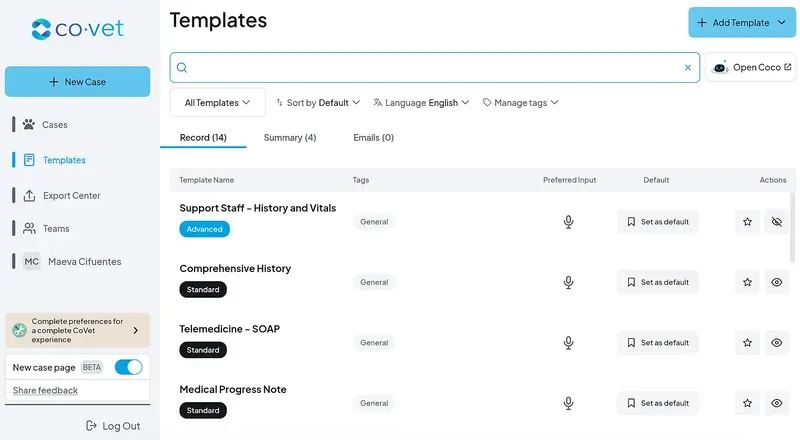
What a complete veterinary exam template should include
A good exam template does two jobs at once. It prompts the examiner through every section of the exam, and it produces a record that someone else can read six months later and understand exactly what was documented. A template only does the second job if it has a place for normal findings as well as abnormal ones.
A complete template covers six field groups. Vitals deserve particular attention: beyond vital signs recording (temperature, heart rate, respiratory rate), this is where fields for body condition score (BCS) documentation, muscle condition score, mucous membrane assessment, capillary refill time (CRT), and hydration status evaluation belong. When the template includes them as standing fields, they show up in every record by default.
Field group | What to capture | Why it matters |
Patient and client info | Patient ID, signalment, owner contact, examiner name and date | Makes the record attributable and retrievable |
History | Chief complaint, current medications, prior conditions, diet, lifestyle | Context that turns isolated findings into a clinical picture |
Vitals | Temperature, heart rate, respiratory rate, weight, BCS, muscle condition score, mucous membranes, CRT, hydration status | Standing fields keep baseline data consistent from visit to visit |
Body systems | Body systems checklist (WNL/ABN) for each system, with space for notes on abnormal findings | Documents that every system was covered, not just the symptomatic one |
Diagnostics | Tests ordered, results, pending items | Connects findings to the workup and flags loose ends |
Assessment and plan | Problem list, working assessment, treatments, client communication, follow-up | Keeps the reasoning behind decisions in the record for continuity |
The WNL/ABN checklist format keeps exams consistent across team members. A template that pairs each checkbox with a free-text field also gives the examiner somewhere to describe abnormal findings, so the record holds more than a flagged box.
Veterinary exam template vs SOAP note
These are different documents doing different work. An exam template is the structured capture of objective findings: vitals, the body systems checklist, and what the examiner observed. A SOAP note is the four-part framework for the full patient encounter, covering Subjective, Objective, Assessment, and Plan. The exam template's contents populate the "O."
Exam template | SOAP note | |
Scope | The physical exam | The full encounter |
Format | Checklist and structured fields | Four-part narrative framework |
When it's filled in | During the appointment | During or after the appointment |
Role in the record | Feeds the Objective section | The complete entry in the medical record |
The workflow runs in sequence: the checklist gets completed in the room, then its contents get transferred into SOAP format. Our guide to Vet SOAP Notes covers the four-part structure in detail, and there's a ready-to-use SOAP Template if you want to standardize that side of the workflow too.
That transfer step is where a clinician using an AI scribe can skip the double entry. Dictating findings once has them organized into both the structured exam fields and the SOAP note. The exam template still defines what gets captured. The scribe removes the re-keying step, without replacing the template.
Veterinary exam templates by visit type
One generic exam form rarely matches every appointment on the schedule. The fields that matter shift with the reason for the visit, and a template suited to the visit type captures those differences without the examiner re-engineering the form each time.
Annual wellness exam template
A wellness template expands beyond the core exam fields to include vaccination status documentation, parasite prevention, diet and weight trends, dental grading, and age-appropriate screening. The problem list in a wellness visit is often brief, and the plan section centers on client education and scheduling the next visit. A template built for this visit type gives those fields a standing place instead of leaving them to free text.
Sick visit and problem-focused exam template
In a problem-focused visit, the chief complaint and medical history take the lead, and the sections for abnormal findings and the differential diagnosis list expand. Assessment becomes the focus of the record, paired with a detailed treatment plan and medication prescribed, plus shorter recheck intervals. The template's job here is to give the expanded reasoning somewhere structured to live.
Pre-surgical exam checklist
A pre-surgical exam checklist adds fields the standard form doesn't carry: pre-anesthetic assessment, ASA status, baseline diagnostics, fasting confirmation, and consent. Each one connects to surgical safety and to the recordkeeping around the procedure, so having them as named fields means the record shows they were addressed before the patient went under.
Recheck and discharge documentation
A recheck template streamlines to the system being monitored, with comparison notes against the prior visit instead of a full repeat of every field. Discharge documentation does the opposite job: it translates exam findings into client-facing instructions the owner can follow at home.
Other veterinary templates to download
Library section, placed after the visit-type and species sections. One short intro line, then the list. This is where the cross-template internal links live, so they don't interrupt the body prose. Present as a two-column table: Template | What it covers. Keep each description to one short line. Use the exact anchor text and URLs from the brief.
Template | What it covers |
Hands-on exam findings: vitals and body-system checklist | |
Four-part framework for the full patient encounter | |
Client-reported history, chief complaint, and background | |
Medications, procedures, and client instructions | |
Print-ready exam form for in-room documentation | |
Guide to writing complete, compliant SOAP notes | |
Client-facing aftercare and follow-up instructions | |
Standard operating procedures for clinic workflows | |
Digital recordkeeping structure and fields | |
Tooth-by-tooth charting for dental procedures |
Species-specific exam templates
A canine exam and a feline exam don't document the same way. Handling differs, stress documentation matters more for cats, and each species carries its own typical findings the examiner expects to note. A species-specific exam form (canine, feline, exotic) builds those differences into the fields rather than leaving them to memory.
Exotic, avian, and equine patients push this further. Their exams emphasize different body systems entirely, so a form built around standard small-animal systems either gets heavily edited per patient or leaves sections blank. Separate templates with the right body-system emphasis solve both problems.
The practical takeaway: adapt the template to the species instead of forcing one form onto every patient. The species-specific fields also depend on good background information, so pairing each exam form with a Patient History Template keeps the client-reported side of the record as structured as the exam side.
For a clinic with a mixed caseload, the workflow advantage of an AI copilot is keeping separate species templates ready to go, so the team selects the right form per patient instead of editing one generic version on the fly.
Digital vs printable formats
The format decision comes down to where you want to spend the effort: before the visit, during it, or after. A printable PDF needs zero setup, but every completed form gets manually transferred into the record afterward. A fillable digital veterinary exam form (built in tools like Jotform or Formstack) takes setup time upfront and removes the legibility problem, but the transfer step into the PMS often remains. AI-assisted capture removes the transfer step itself, since spoken findings get structured into the record directly.
Format | Best for | Tradeoff |
Printable PDF | Clinics that want a free downloadable veterinary physical exam template working today, no setup | Manual transfer into the record after every visit |
Fillable digital form | Standardizing input and ending legibility issues | Setup effort upfront, and transfer into the PMS may still be manual |
AI-assisted capture | Removing the post-visit transfer step | Requires adopting a new tool into the exam workflow |
A useful way to choose: track where the documentation time actually goes in your clinic. If the in-room capture is fast but records get finished hours later, the transfer step is the bottleneck, and that's the problem an AI veterinary scribe addresses. It captures spoken findings and structures them into the record, so the checklist and the final entry stop being two separate tasks. If you'd rather stay paper-based, the Printable Physical Exam Form is ready to use.
Minimum fields for a compliant exam record
Recordkeeping requirements for veterinary medical records are set at the state level, so the authoritative answer for your clinic comes from your own state veterinary board. That said, the fields most state rules expect form a consistent core, and a template that carries all of them means the record meets that baseline by default.
Minimum field | What it covers |
Patient ID | Name, species, breed, signalment |
Client info | Owner name and contact details |
Date and examiner | When the exam happened and who performed it |
History and chief complaint | The pet health history form data and presenting concern |
Exam findings | Objective findings across body systems |
Problem list and assessment | What was identified and the working assessment |
Treatment plan | Medications, procedures, and recommendations |
Follow-up | Recheck plans and client instructions |
Many states also set retention periods for medical records and require entries to be legible, dated, and attributable to the person who made them. Those three requirements are where format matters: an electronic medical records (EMR) template handles legibility and attribution structurally, while handwritten forms depend on the writer. The same logic extends past the exam itself, since documents like a veterinary discharge notes template are part of the same medical record and held to the same standard.
Before adopting any template as your compliance baseline, check it against your own state board's practice act, since requirements vary by state.
How AI scribing fills in your exam template
An AI veterinary scribe listens as the vet speaks and organizes the findings into the template's fields: vitals, body systems, assessment, and plan. The connection to everything above is upstream. When findings are captured by voice at the moment they're observed, there's no separate transfer step from checklist to record, and the record stays consistent from patient to patient.
CoVet works this way with the templates discussed in this guide. The library holds 95+ customizable templates, and custom abbreviations let the team dictate naturally while the record stays standardized, so "left eye" becomes "OS" without anyone correcting it manually. Multi-patient support keeps concurrent cases separate, and completed records export to your PMS via integration or the Chrome extension, with copy-paste available for systems outside the integration list. The same dictation workflow extends to the rest of the record, from the Treatment Plan Template to the operational side covered by a Veterinary SOP Template.
None of this changes the clinical work. The template still defines the structure, the vet still makes every decision, and the scribe can help reduce the time spent moving findings into the record.
Frequently asked questions about veterinary exam templates
What is included in a veterinary exam template for dogs and cats?
A complete template covers six field groups: patient and client information, history, vitals, a body systems checklist, diagnostics, and the assessment and plan. The vitals section carries standing fields for temperature, heart rate, respiratory rate, weight, body condition score, mucous membranes, capillary refill time, and hydration status. Canine and feline versions differ in handling notes, stress documentation, and the species-typical findings the form prompts for.
How is a veterinary exam template different from a SOAP note?
The exam template is the structured capture of objective findings during the physical exam. The SOAP note is the four-part framework for the entire encounter, and the exam template's contents populate its Objective section. In practice the checklist gets completed in the room, then transferred into SOAP format in the record.
Can I use one exam template for every species, or do I need separate ones?
Separate templates work better for mixed caseloads. Exotic, avian, and equine exams emphasize different body systems, so a single small-animal form either gets edited per patient or leaves sections blank. Keeping species variants ready means the team selects the right form instead of reworking a generic one. Specialized procedures follow the same logic, which is why dental work gets its own Dental Chart Template rather than a line on the general form.
What are the minimum fields needed for a compliant exam record?
The core most state rules expect: patient ID, client information, date and examiner, history and chief complaint, exam findings, problem list and assessment, treatment plan, and follow-up. Many states also set retention periods and require entries to be legible, dated, and attributable. Requirements vary by state, so check your own state board's practice act before treating any template as your compliance baseline.
Should I use a printable form or a digital exam template?
It depends on where your documentation time goes. Printable forms need zero setup but every completed form gets manually transferred into the record afterward. A digital format like an Electronic Medical Record template handles legibility and attribution structurally and standardizes input across the team. If the after-visit transfer step is the bottleneck, AI-assisted capture addresses that directly.
Can an AI scribe fill in my exam template during the appointment?
Yes. An AI veterinary scribe listens as you speak and organizes the findings into the template's fields, so the capture and the record stop being two separate tasks. The template still defines the structure, and the vet still makes every clinical decision. CoVet works with 95+ customizable templates and exports completed records to your PMS via integration or copy-paste.
About the Author
)
)
)