)
Veterinary documentation spans the full patient journey, from intake and examination through treatment, discharge, and ongoing recordkeeping. Each stage has its own document type, its own purpose, and its own audience. When those documents are standardized and connected, the record stays complete. When they are not, gaps appear.
This library covers the core templates used across that journey: what each document captures, when it belongs in the workflow, and how to build a template library that holds together across practice types, team sizes, and clinical settings.
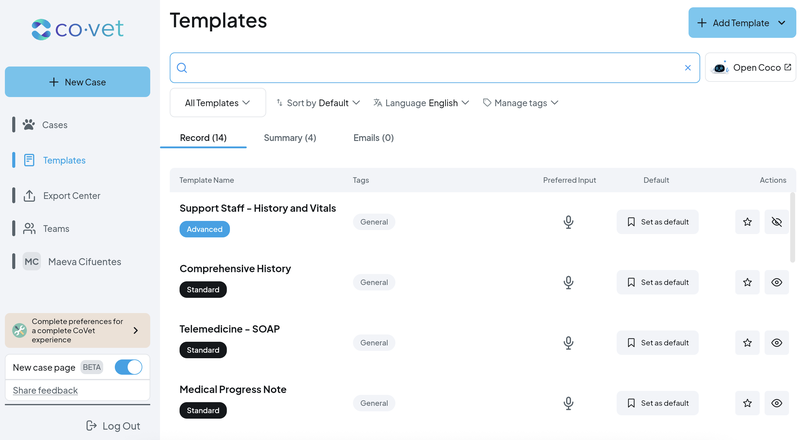
Browse veterinary templates by category
Category | Templates |
Intake and history | |
Exams and assessments | |
Clinical records and reporting | SOAP note template, Veterinary report templates, Patient rounds template |
Treatment and procedures | |
Practice operations and workflows | |
Compliance and logs | |
Client communication |
What veterinary templates are and when you need one
Veterinary templates are structured documents that guide how clinical information is captured throughout the patient visit lifecycle. They can support intake, physical exams, SOAP notes, treatment planning, procedure records, discharge instructions, controlled drug logs, and follow-up documentation.
Standardized templates help veterinary teams capture consistent information while still leaving room for case-specific details and clinical judgment. They provide a shared structure for documentation without prescribing clinical decisions.
The value of structured documentation has been demonstrated across clinical settings. A 2025 study published in Cureus found that introducing a standardized documentation template alongside a targeted training program increased compliance with documentation requirements from 38.2% to 87.2%.
Although the study was conducted in human healthcare, it illustrates how a consistent documentation framework can improve the completeness of clinical records.
Veterinary document types at a glance
Document type | Used during | Primary purpose |
First visit or intake | Establish baseline medical and owner information | |
Every visit | Document systems-based findings | |
Any visit requiring clinical assessment and decision-making | Record clinical reasoning and care decisions | |
During active treatment or hospitalization | Track medications administered and tasks performed | |
Each shift review for hospitalized patients | Support handoffs and updated care planning | |
At discharge | Provide client-facing home care guidance | |
On-going | Maintain compliance records | |
Dental procedures | Record tooth-specific findings and treatments |
What to include in a veterinary template library
A complete veterinary template library supports every stage of the patient visit, from intake through discharge. Each document serves a different purpose, but together they create a consistent documentation workflow.
Intake and patient history
Before the exam begins, you need a reliable picture of the patient. The patient history form captures signalment, owner concerns, current medications, vaccination status, and relevant medical history.
This information provides context for the physical examination and helps establish a baseline for the visit.
Exam and assessment documentation
Physical examination templates support systematic, head-to-tail documentation of findings during routine and follow-up visits.
The Physical exam templates prompts clinicians to record each body system in sequence, which helps maintain consistency across clinicians and visit types.
For practices that prefer a paper-based option, a printable exam form provides the same structure in a format that works outside a screen-based workflow.
Clinical records and reports
This is the core of the medical record: the documents that capture what was assessed, what was decided, and what happened next. Depending on the situation, this may include SOAP notes, patient rounds documentation for hospitalized patients, or more detailed veterinary reports.
Treatment and procedure documentation
Once treatment begins, a separate set of documents records what was done. This includes treatment sheet template for medications, treatments, completed tasks, and their timing, as well as dental charts for tooth-specific findings, procedures, and treatment decisions.
Compliance logs
Some documentation exists primarily to meet regulatory and recordkeeping requirements. The controlled drug log tracks dispensing and administration of controlled substances, supporting DEA compliance and internal audit readiness.
Maintaining this log as part of a standard template library, rather than as a separate manual process, reduces the risk of gaps surfacing during inspections.
Cover documentation used to meet regulatory and record keeping requirements.
Client-facing communication
A complete template library should also include documents that guide client communication after the visit.
Discharge instructions templates outline home care, medication schedules, activity restrictions, follow-up recommendations, and signs that warrant another veterinary visit. They help ensure owners leave with consistent, easy-to-reference care instructions.
Adapting your template library by practice type
The core documents in a veterinary template library are similar across practices, but the templates you rely on most will vary depending on your workflow, patient population, and clinical setting.
The table below highlights the templates that typically take priority across different practice types.
Practice type | Priority templates | Why |
General practice | History form, exam template, SOAP note, discharge instructions | Core visit documentation |
Emergency and critical care | Patient rounds, treatment sheet, SOAP note | Multi-day cases and shift handoffs |
Multi-location or specialty practice | Full standardized library | Consistency across teams and sites |
Equine and large animal practice | Exam template, treatment sheet | Support field documentation workflows |
Common veterinary documentation problems and how to fix them
Even with a complete template library, documentation problems can arise when templates are used inconsistently or disconnected from one another. The sections below cover the most common failure points and how a connected template workflow helps address them.
Inconsistent formats across clinicians
When clinicians document the same type of visit in different ways, records become harder to review, compare, and hand over. Research published in PLOS Digital Health by researchers at Colorado State University also identifies inconsistent data formats across veterinary medical records as a challenge for using and sharing clinical data across practices.
Using a shared veterinary report template gives every clinician the same structure for documenting patient encounters, surgical procedures, and diagnostic findings, regardless of who is on shift.
Problem | Why it matters | Fix |
Each clinician uses a different format | Records are harder to read, compare, and audit across the team | Use a shared template library with a standardized structure for each document type |
Terminology varies across the team | Information gets lost in translation during handoffs | Align on consistent field names and section order across all document types |
Gaps between intake and exam documentation
A patient history only has value if it informs the physical examination that follows. When the two records are not connected within the documentation workflow, important background information can be missed before exam findings are recorded.
The 2025 AAVMC Competency-Based Veterinary Education Milestones identifies two common characteristics of novice clinical practice: collecting a patient history by following a template without consistently obtaining complete or relevant information, and performing physical examinations that lack a systematic approach and may miss important findings.
Problem | Why it matters | Fix |
History form completed but not referenced during the physical exam | Relevant background information may not inform the clinical assessment | Use linked templates that prompt clinicians to review intake information before documenting exam findings |
Physical exam documented without reviewing intake information | Important history can be overlooked before examination findings are recorded | Standardize the intake-to-exam handoff as part of the visit workflow |
Together, these behaviours highlight the need for workflows that connect intake documentation with examination records.
Using a standardized workflow that links the patient history form to the physical exam template helps ensure clinicians review intake information before documenting examination findings, reducing the likelihood that relevant history is missed.
Mixing clinical records and discharge instructions
A medical record and discharge instructions are created from the same consultation, but they serve different purposes. Mixing them can leave the clinical record without enough detail for the care team or overwhelm the client with information that isn't relevant to home care.
Evidence from the AAVSB's 2025 medical recordkeeping guidance reinforces this distinction. Examination findings, differential diagnoses, treatment plans, and medication details are part of the medical record, while written discharge instructions are listed as a separate documentation requirement.
Keeping these as separate templates helps each document serve its intended audience.
Document | Written for | Primary purpose |
Medical record | Veterinary team | Clinical decision-making and legal documentation |
Discharge instructions | Pet owner | Home care guidance, medications, restrictions, follow-up care, and warning signs |
Treatment documentation disconnected from patient rounds
Treatment records and patient rounds document different parts of the same case. When they are completed independently, information can be lost during shift changes or ongoing care.
The RCVS Code of Professional Conduct supporting guidance on clinical records states that clinical records should provide a complete and relevant account of the patient's clinical history to support continuity of care. This includes treatments already given as well as proposed or ongoing investigation and treatment plans.
Using treatment sheet and patient rounds templates together helps keep those records connected.
Problem | Why it matters | How to fit it |
Treatment records maintained separately from patient rounds | Important treatment details and ongoing care plans may not carry through between clinicians | Use treatment sheet and patient rounds templates together as part of the same documentation workflow |
Building your template library with CoVet
CoVet is an AI veterinary scribe that captures what you dictate during or after the appointment and structures it into the appropriate template, whether that's a patient history, physical exam, SOAP note, treatment sheet, patient rounds documentation, or discharge instructions.
Practices can customize more than 95 veterinarian-built templates to match their documentation workflows. Completed records can also be synced with supported practice management systems through PMS integrations or transferred using the Chrome extension for web-based systems.
Each stage of the visit is documented in the template designed for it, from intake through discharge. This helps reduce duplicate documentation while keeping the patient record complete and consistently structured.
Frequently asked questions
What's the difference between a SOAP note and a general veterinary report?
A SOAP note follows a structured clinical format for documenting an individual patient encounter, while a veterinary report provides a broader summary for referrals, case updates, or other reporting needs.
Do I need separate templates for intake and exam documentation?
Yes, keeping patient history and physical examination in separate templates helps ensure background information is collected before clinical findings are documented.
How do controlled drug logs fit into a practice's template library?
Controlled drug logs are compliance records that document the receipt, use, and inventory of controlled substances separately from the patient's medical record.
Can templates be shared across a multi-location practice?
Yes, standardized templates help maintain consistent documentation across clinicians, teams, and practice locations.
How do discharge instructions differ from the clinical record?
The clinical record documents what was found and decided for the care team; the discharge instructions template translates that into home care guidance written for the pet owner.
About the Author
)
)
)