)
You can use a free acupuncture SOAP note template here, built for veterinary acupuncture visits. Acupuncture sessions are hard to capture consistently in a standard SOAP form, since point selection, technique, and the patient's response across a series of visits rarely have a clear place to go.
This guide gives you a ready-to-use template, plus how to write acupuncture SOAP notes that hold up for continuity of care, team communication, and compliance.
Download your free acupuncture SOAP note template
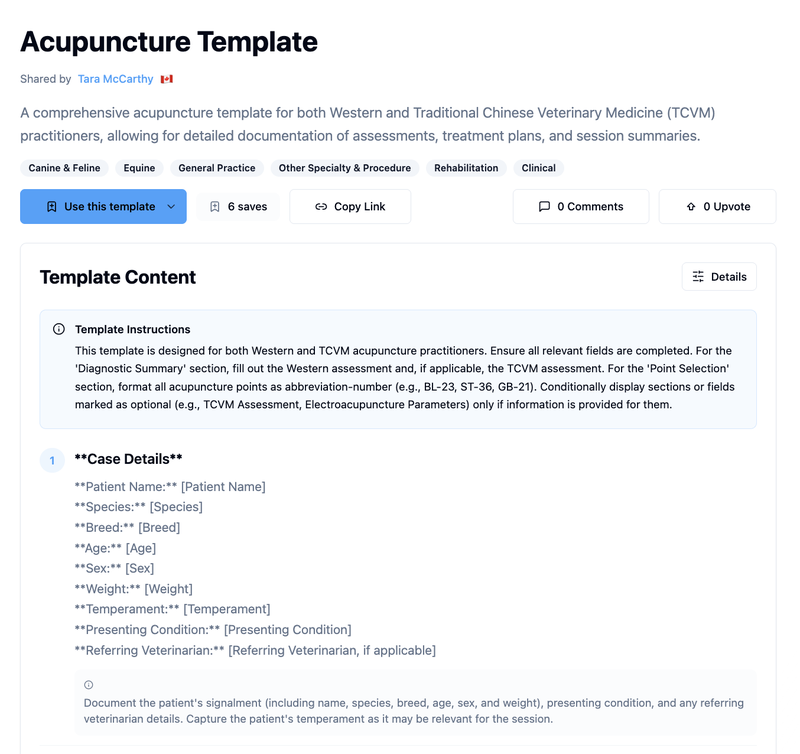
The template works alongside the rest of your intake paperwork, so it stays consistent with your existing acupuncture forms and patient intake form from the first consultation through every follow-up session.
What goes in an acupuncture SOAP note
The SOAP format, short for Subjective Objective Assessment Plan, gives every veterinary visit a consistent structure. An acupuncture visit fits that same structure, but each section carries information a routine wellness note would not. The points you chose, the needle technique, and the way the patient responds over a series of sessions all need a clear home in the record.
Strong acupuncture documentation captures those specifics in a way any team member can read and continue. The table below shows how each SOAP section adapts to an acupuncture visit and why the detail matters for continuity and care. Use it as a reference when you set up your own SOAP documentation, and keep the patient treatment details specific enough that the next clinician can repeat your approach without guessing.
SOAP section | What to capture for acupuncture | Why it matters |
Subjective | Owner-reported changes since the last session: mobility, pain signs, appetite, energy, and behavior at home. | Owners see the patient between visits. Their observations are often the first signal that a treatment plan is working or needs adjusting. |
Objective | Physical and TCVM exam findings, tongue and pulse, points selected, needle type and retention time, and electroacupuncture settings if used. | These are the measurable, repeatable facts of the session. Precise point and technique logging lets anyone on the team reproduce the treatment. |
Assessment | Response to prior sessions, pattern diagnosis, and progress against the goals set at intake. | Acupuncture results build across visits, so the assessment ties today's session to the arc of care rather than treating it in isolation. |
Plan | Next session timing, adjustments to the point plan, and home care instructions for the owner. | A clear plan keeps the series on schedule and gives the owner concrete actions to take between appointments. |
Thorough documentation across all four sections is what turns a single session into a trackable treatment series. The richer the entry, the easier it is to see whether the plan is working.
How to write acupuncture SOAP notes
A complete acupuncture note records the session precisely enough that another clinician could pick up the case, then connects today's findings to how the patient responds over the course of treatment. The sections below cover how to do that.
Documenting point selection and technique
Write down each point you used by its standard nomenclature and laterality, for example BL-23 left or ST-36 bilateral. Record the needle gauge and depth, retention time, and any electroacupuncture or aqua-acupuncture settings, since those are the details that make a session repeatable on the page. When the specifics are in the record, treatment recording stays consistent across a series, and a colleague who picks up the case can see exactly what was done. That consistency is what makes acupuncture treatment notes useful to the whole team rather than only to the person who wrote them.
Tracking response across a series
Because an acupuncture course is documented across several visits, each note reads better when it references the prior session's response and the patient's progress toward the goal set for them. Recording the same outcome measure every visit, such as a mobility score or a pain score, keeps progress tracking comparable from one session to the next. Reading back through the acupuncture progress notes then shows the trend at a glance, so the record supports your clinical decisions instead of leaving you to reconstruct them from memory.
Keeping notes safe and compliant
Acupuncture records should meet the same documentation standards as the rest of the medical record, since the AVMA holds all aspects of veterinary medicine to the same standards, including integrative care. Keep entries legible, dated, and attributable to the clinician who performed the treatment, and since record retention rules differ from one state or province to the next, apply the minimum your board requires. Note informed consent for acupuncture before the first treatment, and record any adverse response afterward. Documenting that the treatment happened within a valid veterinarian-client-patient relationship keeps the record defensible. Safe clinical documentation like this protects you if a record is ever reviewed, which comes down to treating the note as a professional document rather than personal shorthand.
Acupuncture SOAP note example
Here is one worked example for a senior dog on an osteoarthritis mobility plan, annotated to show what makes each section complete rather than to teach the treatment itself. The patient is Bailey, an 11-year-old spayed female Labrador retriever, seen for her third session in an initial course.
Subjective Owner reports Bailey is rising from her bed more easily over the past week and managing the back porch steps without help. Morning stiffness is still present but shorter than before. Appetite and home demeanor unchanged, no GI upset after the last session. What makes it complete: a specific owner-reported change tied to the previous session, not a general "doing well." That is the patient treatment detail the rest of the note builds on. Objective Exam: improved range of motion on hip extension compared with session 2, mild crepitus in both stifles, no reaction at prior needle sites. TCVM: pale, slightly lavender tongue, deep and weak pulses, pattern read as Kidney deficiency with local stagnation. Points: BL-23 bilateral tonifying, GB-30 over both hips, ST-36 bilateral, local stifle points, dry needle with E-stim across the hip points. Needle retention 20 minutes. Patient settled and calm throughout. Mobility score 6 on the clinic's 0 to 10 scale, up from 4 at session 1. What makes it complete: every point logged by name, side, and technique, plus retention time and a repeatable scored outcome, so the session can be reproduced and compared next time. Assessment Osteoarthritis-related mobility loss responding to treatment, with owner-reported function and the mobility score both trending up across three sessions. No adverse response to needling or E-stim to date. What makes it complete: it reads as an acupuncture progress report, tying today to the arc of care instead of standing alone. Plan Continue weekly sessions and reassess after session 5. Hold the current point plan given the response, with a local stifle point to add next visit if morning stiffness persists. Home care unchanged, owner to note any setbacks before the next appointment. What makes it complete: concrete next-session timing, a clear decision to hold or adjust, and a home-care instruction the owner can act on. |
Other veterinary templates to download
A consistent acupuncture note works best alongside the rest of your records, and these veterinary templates and guides cover the documentation around it.
Template | What it covers |
Guide to writing complete, compliant SOAP notes | |
Downloadable, print-ready SOAP note template | |
How clinics automate SOAP documentation | |
Vitals and body-system exam findings | |
Print-ready exam form for in-room use | |
Client-reported history and background | |
Treatment plans, medications, and instructions | |
Digital recordkeeping structure and fields |
How AI scribing speeds up acupuncture notes
An AI veterinary scribe listens while you speak during or after the session and organizes what you say into SOAP sections, including the points you used, the technique, and how the patient responded. Dictating while the session is still fresh means point selection and response detail land in the record accurately, rather than being reconstructed from memory at the end of the day.
Because acupuncture documentation varies by clinic, CoVet's templates are customizable. You can adapt one of its 95+ templates to your acupuncture workflow, or build one from scratch with CoCo, and set custom abbreviation corrections so your shorthand expands the way you write it. It supports multiple patients in a single visit and exports the finished record to your practice management system through an integration or the Chrome extension, or by copy-paste where a direct integration isn't available.
Used this way, AI SOAP notes can help reduce the time spent writing up acupuncture sessions after hours, while keeping team notes consistent across a treatment series. SOAP notes software like this documents the decisions you have already made. It does not make them for you.
Frequently asked questions about acupuncture SOAP notes
What should an acupuncture SOAP note include?
The same four sections as any SOAP note, with detail specific to the visit. Subjective covers owner-reported changes since the last session. Objective covers your exam findings, any TCVM assessment, the points you selected, the technique, retention time, and electroacupuncture settings if used. Assessment ties the response to the patient's progress against the treatment goal, and Plan covers next session timing and home care. The difference from a routine note is the point and technique detail, which is what makes the session repeatable later.
How do I document point selection and needle technique?
Record each point by standard nomenclature and laterality, for example BL-23 left or ST-36 bilateral, and note the technique next to each one. Capturing depth, retention time, and any electroacupuncture or aqua-acupuncture settings in the same place keeps the entry specific enough that a colleague can see exactly what was done. Consistent formatting across visits is what makes the points easy to compare from one session to the next.
How do I track patient progress across acupuncture sessions?
Record the same outcome measure at every visit, such as a mobility score or a pain score, so the numbers stay comparable over the course. Reference the prior session's response in each new note, rather than starting fresh each time. Reading the entries in sequence then shows whether the patient is improving, holding, or regressing, which supports your decision to continue, adjust, or space out treatment.
Do I need a separate template for acupuncture, or can I adapt my standard SOAP note?
Either works. A standard SOAP note gives you the backbone, but it usually lacks dedicated fields for point selection, technique, retention time, and a TCVM pattern, so you end up writing those into a notes field inconsistently. Adding those fields to your existing template, or using one set up for acupuncture, keeps the detail structured and quicker to complete. The right choice depends on how often you do acupuncture and how many people in the practice need to read the records.
How long do I need to keep acupuncture treatment records?
Acupuncture records follow the same retention rules as the rest of the medical record, and those are set by your state or provincial board rather than a single national standard. Periods vary, so check your own board's requirement and apply it consistently across the practice. Where litigation is a possibility, many practices retain records beyond the minimum, including for patients that are inactive or deceased.
Can an AI scribe write my acupuncture notes during the session?
An AI scribe can capture the session by dictation during or after the appointment and organize what you say into SOAP sections, including the points and the patient's response. It can help cut down the writing you do afterward, since the detail is recorded while the session is fresh rather than reconstructed later. It documents the decisions you have already made, it does not make them for you.
About the Author
)
)
)