)
)
An AI scribe changes when and how documentation gets done.
Instead of rebuilding the appointment from memory later, you start with a structured draft based on what was captured in the room. That reduces the work involved in recall, composition, SOAP formatting, PMS entry, and follow-up documents.
You still review and approve the final record.
Key takeaways
A SOAP note is not one task. It is a series of documentation steps.
A major source of wasted time is recall, especially when notes are finished hours after the appointment.
In CoVet's 11-practice VMG pilot, the share of participants completing daily documentation in under 30 minutes increased from 0% to 45%.
Clinicians still need to review and approve AI-generated records.
Discharge summaries, referral letters, and client messages add another layer of documentation that AI can help produce from the same appointment.
The usual explanation misses the point
The standard explanation for an AI scribe is that it listens to the appointment and writes the note.
That explains the output. It does not explain why the workflow gets shorter.
Dictation and transcription can reduce keystrokes, but they still leave you with several jobs:
Remember what happened.
Decide what belongs in the record.
Turn it into clinical prose.
Organize it into the right sections.
Enter it into the patient record.
Write anything that needs to follow.
The documentation burden comes from the whole sequence.
That is why the benefits of a veterinary AI scribe go beyond producing the medical record. The same captured appointment can support follow-up communication, reduce repetitive documentation, and make it easier to move finished records into the systems your team already uses.
Where the time actually goes
Break one appointment's documentation into seven stages:
Stage | What it involves | What drives the workload |
|---|---|---|
1. Recall | Reconstructing what happened during the appointment | How much time has passed |
2. Clinical triage | Deciding what belongs in the record | Clinical judgment |
3. Composition | Turning the appointment into clinical prose | Writing effort and fatigue |
4. Structuring | Organizing information into S, O, A, and P | Template fit and formatting |
5. Entry | Getting the note into the system of record | Typing, pasting, and switching systems |
6. Derived documents | Creating discharge summaries, client messages, and referral letters | Rewriting the same information |
7. Review and approval | Confirming the record is accurate | Clinical responsibility |
AI scribes affect each stage differently.
The biggest opportunities sit in recall, composition, structuring, entry, and follow-up documentation.
Recall disappears
This is one of the easiest costs to underestimate.
Finish a note immediately after an appointment and the details are still fresh. Finish it two hours and six patients later and you have to reconstruct what happened.
That reconstruction takes time.
It also gets harder as the day goes on.
Capturing the appointment while it happens means there is much less to rebuild later. The draft starts with the details from the conversation instead of your memory of the conversation.
Composition becomes review
Turning:
"She's been off her food since Thursday. Owner thinks it started after the kennels."
into concise clinical language requires thought.
Doing that repeatedly across a full day adds up.
An AI scribe can produce the first clinical draft from the appointment. Instead of staring at an empty field, you start with something you can review and correct.
That changes the job from writing to editing.
Structuring becomes automatic
SOAP structure also takes work.
Information has to land in the right part of the record. Your team may also have specific conventions for how histories, assessments, plans, or normal findings should appear.
A scribe can apply that structure while generating the draft.
With customizable SOAP notes, the format can follow how your practice documents instead of forcing every clinician into the same generic template.
PMS entry depends on the integration
This part varies significantly between products.
If you still need to copy a finished note from one window and paste it into your practice management system, there is still a manual handoff.
An integration can remove much of that work by sending approved documentation into the patient record.
CoVet works alongside existing practice management systems. You can see the currently supported options on our integrations page.
When evaluating a veterinary AI scribe, ask:
Once I approve the note, what do I have to do to get it into the patient record?
The answer matters as much as note generation itself.
Follow-up documents are part of the workload too
A SOAP note is rarely the final piece of writing attached to an appointment.
You may also need:
a discharge summary
a client email
care instructions
a referral letter
a summary for the referring veterinarian
These documents usually contain the same clinical information written for a different reader.
Once the appointment has been captured, that information can be reused instead of reconstructed each time.
The effect can go beyond time saved.
In CoVet's VMG pilot, the share of respondents attaching discharge summaries to more than half of appointments increased from 26% to 45%. Thirty-six percent also reported better client follow-through on treatment recommendations.
That suggests some of the regained capacity goes back into communication that teams previously struggled to fit into the day.
We cover that in more detail in how veterinary AI scribes help with client communication.
Clinical judgment stays with the veterinarian
Some parts of documentation should not disappear.
Clinical triage
The clinician still decides what is relevant.
Software can organize and draft what was captured. Clinical significance still requires veterinary judgment.
Review and approval
The clinician of record is responsible for the final note.
AI-generated documentation should still be read, corrected where necessary, and approved before it becomes part of the medical record.
That review is also why evaluating accuracy matters.
Rather than relying on a single vendor accuracy percentage, test the software against real appointments from your own practice. We outline one approach in our guide to veterinary AI scribe accuracy.
Look beyond the average
"Saves X hours per day" is easy to understand.
It also hides a lot.
In CoVet's 11-practice VMG pilot, daily documentation time changed like this:
Daily documentation time | Before | After |
Under 30 minutes | 0% | 45% |
1 to 2 hours or more | 68% | 18% |
More than 2 hours | 11% | 0% |
The change in the longest documentation days is particularly meaningful.
Those are the days when notes consume breaks, delay the trip home, or make evening plans difficult.
Participants also rated record quality at 4.5 out of 5 after adopting CoVet, compared with 3.4 beforehand. Colleague readability increased from 3.9 to 4.9.
These results came from CoVet's own pilot and were self-reported by participants across 11 practices. They show what changed for those teams, rather than guaranteeing the exact same result elsewhere.
You can also hear directly from veterinary professionals using CoVet in our customer stories and testimonials.
The best comparison is your own baseline.
Measure the difference in your practice
You can get a useful answer with two weeks of simple measurement.
Measure one normal week. Record when the last appointment finishes and when the day's documentation is actually complete.
Include follow-up documents. Count discharge summaries, referral letters, client emails, and other writing attached to the appointment.
Change one variable. Introduce the scribe without simultaneously rebuilding your entire documentation process.
Measure again. Compare documentation completion time and anything that was delayed or skipped.
Look at what happened to the end of the day. If the final hour is still being consumed by admin, another part of the workflow may be the constraint.
That last point matters.
Veterinary teams rarely use one piece of software in isolation. The work between systems can create its own burden, which we explore in why veterinary teams feel overwhelmed by their software.
Frequently asked questions
How do AI veterinary scribes reduce time spent on SOAP notes?
They capture the appointment while it happens and generate a structured clinical draft. This reduces the time spent reconstructing the appointment from memory, writing the note from scratch, formatting it into SOAP structure, and producing related documents afterwards.
Is an AI scribe just faster dictation?
No. Dictation mainly reduces typing. You still have to decide what to say, organize the information, and turn the appointment into a clinical record.
An AI scribe uses the appointment itself to create a structured draft for review.
How much time do AI scribes save on veterinary documentation?
It depends on the practice and its existing workflow.
In CoVet's 11-practice VMG pilot, the share of participants finishing daily documentation in under 30 minutes increased from 0% to 45%. The share spending more than two hours per day dropped from 11% to 0%.
Measuring your own documentation time before and after adoption gives you the most useful answer.
Do veterinarians still need to review AI-generated SOAP notes?
Yes.
The clinician remains responsible for the final medical record. AI-generated notes should be reviewed, corrected where needed, and approved before they are finalized.
Can an AI scribe send notes to a practice management system?
Some can.
The exact workflow depends on the scribe and the practice management system. With a supported CoVet integration, approved documentation can be sent back to the patient record.
If your workflow still requires copying and pasting manually, that step remains part of the documentation process.
Where else can an AI scribe save documentation time?
Follow-up documents can account for a significant amount of work.
Discharge summaries, client messages, care instructions, and referral letters often use the same information already captured during the appointment. Generating them from that shared context reduces the need to write the same details again.
Do faster veterinary notes mean worse notes?
They do not have to.
A note captured during the appointment starts closer to the original conversation than one reconstructed from memory later in the day.
In CoVet's VMG pilot, participants reported higher record quality and colleague readability after adoption. Clinician review remains the final safeguard.
About the Author
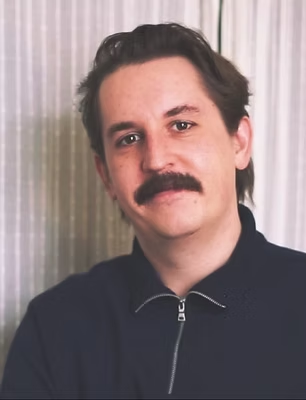
Iain MacNeil
Iain MacNeil is the Content Manager at CoVet. He's the one behind most of what you read here (the copy, the guides, the launch emails, the brand voice) and he's spent the last ten-plus years turning complicated things into stuff people actually want to read. He studied Creative Writing at Concordia, lives in Montreal, and can still land a kickflip despite being in his mid-30s.
)
)
)