)
)
Veterinary notes are hardest to keep accurate and timely when clinicians have to choose between documenting during the appointment and staying present in the room. Write during the consult and the record may compete for your attention. Write later and the details start to fade.
That trade-off sits behind most documentation problems.
Key takeaways
Accuracy is highest when the appointment is still fresh.
Delaying documentation increases the risk of losing specific clinical detail.
Copy-forward can save time while introducing old or incorrect findings.
Templates affect what gets recorded by shaping what clinicians are prompted to capture.
You can spot most documentation problems by reviewing a small sample of closed records.
The trade-off, plainly
A veterinary record has to be accurate.
It needs to reflect what you saw, what you decided, and why. The closer the note sits to the appointment, the easier it is to preserve the specifics: the exact quadrant, the owner's wording, the number on the scale.
It also has to be timely.
The record needs to be available for the next clinician, the client, the insurer, and the legal record while the information still matters.
Both goals are easiest to meet when documentation happens close to the appointment.
That is also when the clinician's attention belongs to the animal and owner in front of them.
Most documentation problems start there.
The documentation problem changes with the way you practice
The pressure points are not the same in every veterinary setting.
In a general practice clinic, the challenge is often volume. Appointments run back to back, several people may contribute to the record, and unfinished notes can accumulate quickly when the day gets busy.
For mobile and house-call veterinarians, documentation has to move with you. Notes may be captured between stops, in the car, or somewhere with unreliable service. That makes a workflow that depends on getting back to a desktop much harder to maintain.
For equine and large-animal veterinarians, many of the same pressures are amplified by working in the field. The exam may happen in a barn or on a farm, with both hands occupied and limited connectivity. Documentation needs to fit around the visit rather than pulling the clinician back to a workstation afterward.
The right documentation workflow depends on where you work, what a typical appointment looks like, and what has to happen to the record afterward.
What makes veterinary notes less accurate?
Delaying the note
An hour after the appointment, you usually remember the shape of the case.
A few hours and several patients later, the specifics begin to blur.
“Mild left-sided discomfort on palpation” becomes “some discomfort.” The general meaning survives, but the detail that helps the next clinician judge whether anything has changed is gone.
That loss happens gradually and often goes unnoticed.
Rebuilding the memory
Writing several hours later does not always feel uncertain.
The mind fills gaps with what usually happens, creating a complete and convincing version of the appointment.
That is what makes this risky.
A reconstructed memory can feel just as clear as a fresh one, even when some of the details were filled in after the fact.
Copy-forward and cloned notes
Duplicating the previous visit's note can save time, but it creates two common risks.
Old findings can survive into a new record even when they were not re-examined.
Real changes can also get missed because the surrounding text still describes the previous visit.
Over time, that makes the record less reliable as a timeline of what actually changed.
A template that does not fit the appointment
Templates shape what clinicians look for and what they record.
A routine wellness template used for a complicated internal medicine case may provide plenty of structure for minor details while leaving nowhere sensible for the finding that matters most.
The important information then gets buried in free text or left out.
The opposite can happen too. Too little structure can leave you with records that are difficult to scan later.
Multiple authors with unclear attribution
A technician takes the history and vitals. A vet examines and assesses. Someone adds a phone conversation two days later.
If the record does not make clear who documented each part and when, the next reader cannot easily tell what was observed firsthand and what was relayed later.
Each entry may be correct on its own. The uncertainty comes from how they fit together.
What makes veterinary notes late?
Saving everything for the end of the day
End-of-day batching pushes the whole documentation workload into the part of the day when there is often the least energy left.
It also makes the notes older.
The records requiring the most thought may end up getting written when recall is weakest and attention is already stretched.
Interruptions
Documentation is particularly sensitive to interruption.
Every time a note is paused, the clinician has to reload the appointment into working memory before continuing.
A note interrupted three times can take much longer than one uninterrupted note, with more opportunities for a detail to disappear along the way.
Documentation debt
An unfinished note gets harder to close the longer it stays open.
The recall it depends on keeps fading, so each old note requires more reconstruction.
Once several notes accumulate, the backlog starts feeding itself. Older notes take longer to finish, which leaves less time for the newer ones.
If that backlog has already formed, why veterinary notes fall behind and how to catch up covers the recovery side.
Where each problem shows up
Some documentation problems mainly affect accuracy. Others create delays. Several do both.
Documentation problem | Main effect | What happens |
|---|---|---|
Delaying the note | Accuracy + timeliness | Specific detail fades while the record stays open |
Reconstructed memory | Accuracy | Missing details can be filled in without the writer noticing |
Copy-forward | Accuracy | Old findings can carry into the new record |
Poor template fit | Accuracy + timeliness | Important details are harder to capture and find |
Unclear author attribution | Accuracy | Readers cannot easily tell who observed what |
End-of-day batching | Accuracy + timeliness | Notes are written later, when recall and energy are lower |
Interruptions | Timeliness | Every restart adds time and increases the chance of losing detail |
Documentation backlog | Accuracy + timeliness | Older notes take longer to finish as memory fades |
The pattern is fairly simple: the longer documentation gets separated from the appointment, the harder it becomes to preserve detail and close the record quickly.
Audit your own records in about an hour
You do not need a large study to see whether this is happening in your practice.
Start with 20 consecutive closed records from a normal week.
Measure time to close. Record the time between appointment end and note sign-off. Look at the median and the three longest delays.
Compare clinical detail. Look for specific, quantified, or qualifying statements. Are later notes consistently thinner?
Flag copy-forward. Check for long passages that match the previous visit. Confirm whether those findings were actually re-examined.
Check attribution. In records touched by several people, can you tell who observed or added each piece of information?
Test readability. Give a few records to a colleague and ask them to explain the plan without asking you for context.
If they cannot, something needs to change.
The six dimensions of clinical note quality used to assess AI-generated records can also be applied to human-written notes.
Breaking the trade-off
The real problem is having to choose between documenting close to the appointment and protecting attention in the room.
That changes when the appointment can be captured without requiring the clinician's hands or eyes.
A veterinary AI scribe can record the conversation during the consult and turn it into a draft note afterward. That keeps documentation close to the source while allowing the clinician to stay focused on the appointment.
The review step still matters.
You still read and sign the record. The final note carries your clinical judgment.
You still decide what matters. Software can structure the information, but the clinician decides what is relevant.
Your templates still need to fit the work. A general practice template will not suit every exotics, equine, emergency, or referral case.
Customizable SOAP note structures help practices match documentation to the way they actually work.
In CoVet's pilot across 11 VMG practices, participants rated record quality 4.5 out of 5 after adoption compared with 3.4 before. Colleague readability increased from 3.9 to 4.9.
Those figures came from CoVet's own pilot and were self-reported. The 20-record audit above gives you a way to measure the same problem in your own practice.
Frequently asked questions
What makes it hard to keep veterinary notes accurate and timely?
Both accuracy and timeliness depend on documenting close to the appointment. That is also when the clinician's attention belongs to the patient and owner. Writing later protects the consult, but increases the chance that specific clinical details will be lost.
How quickly does clinical recall fade?
The broad shape of an appointment tends to last longer than its details.
Specific measurements, locations, wording, and qualifying findings are usually the first things to become harder to recall. That is why notes written later can still sound complete while containing less useful detail.
Is copying forward the previous visit's note acceptable?
Copy-forward creates an accuracy risk when previous findings are carried into a new note without being confirmed.
It can also make genuine changes harder to spot because large sections of the record remain unchanged.
Does writing notes faster make them less accurate?
Speed alone is not the main issue.
A note captured close to the appointment can preserve more detail than a carefully written note completed several hours later.
Should notes be written during or after the appointment?
The closer documentation sits to the appointment, the easier it is to preserve detail.
The challenge is capturing that information without taking attention away from the patient and owner.
How can we tell whether our records have this problem?
Review 20 consecutive closed records and compare how long each one took to close with the amount of specific clinical detail it contains.
If later records consistently contain less detail, documentation delay is affecting record quality.
Do AI scribes remove the need to review notes?
No. The clinician remains responsible for the accuracy of the final record. An AI scribe changes how the first draft is captured. It does not change who reviews and approves it.
About the Author
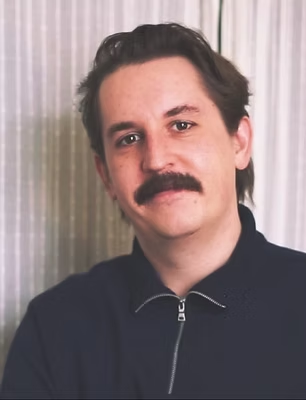
Iain MacNeil
Iain MacNeil is the Content Manager at CoVet. He's the one behind most of what you read here (the copy, the guides, the launch emails, the brand voice) and he's spent the last ten-plus years turning complicated things into stuff people actually want to read. He studied Creative Writing at Concordia, lives in Montreal, and can still land a kickflip despite being in his mid-30s.
)
)
)