)
A veterinary new client form is the foundation of a consistent intake process. It captures the owner information, patient details, consent documentation, and billing data needed to establish the patient record before the first appointment.
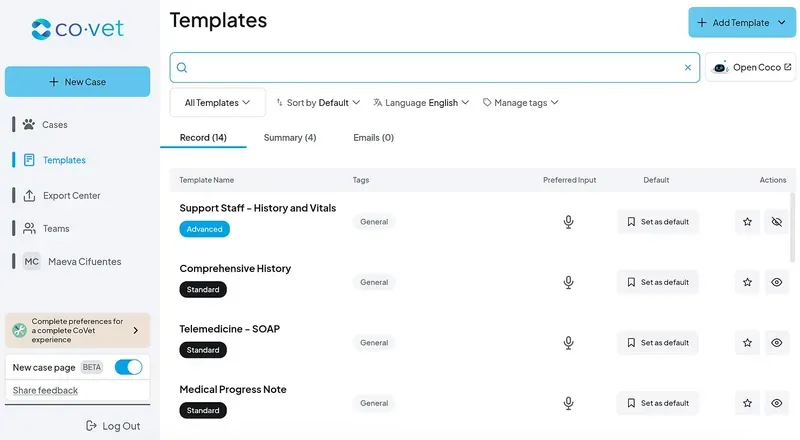
CoVet's template builder allows veterinarians to create and customize forms that match their workflows.
This article explains what to include in a veterinary new client form, how to adapt it for different practice types, and why standardized intake supports more consistent documentation across the practice.
Check out our other templates
Discharge instructions template
Report template (Histopathology)
Printable physical exam form template
What a veterinary new client form is and when you need one
A veterinary new client form is the document a practice uses to collect owner contact information, patient identification details, consent authorizations, and billing information before the first appointment.
It's the first clinical document in the patient relationship, and almost every record that follows draws from it.
When a new client form is complete, the front desk has what's needed to set up the patient file, and the veterinarian walks in with key details already documented. When it's incomplete, the veterinarian may need to collect and verify that information during the appointment, which can add administrative work and increase the likelihood of inconsistencies.
New client form vs. related intake documents
The new client form is often confused with the patient history form, but they serve different purposes and are completed at different points in the intake process.
Document | Primary purposes | Completed by | When |
New client form | Owner information, patient identification, consent, billing | Client | Before of after first visit |
Clinical background and presenting complaint | Client or front desk | Intake or check-in | |
Systems-based exam findings | Clinician | During the appointment | |
Clinical reasoning and treatment decisions | Clinician | During or after the |
The new client form captures administrative and consent information whilst the patient history form captures clinical context. Both are needed, and neither replaces the other.
Why standardized intake matters
Incomplete intake forms could create additional work before the appointment begins, including follow-up requests for missing vaccination histories, incomplete medication lists, and unsigned consent sections.
A standardized veterinary new client form creates a consistent process for collecting owner information, patient history, emergency contacts, consent, and billing details before the veterinarian enters the room. For multi-doctor and growing practices, that consistency supports smoother handoffs between reception, technicians, and clinicians.
A 2025 survey by the Virginia Veterinary Conference Association found that 19% of respondents identified client communication and compliance as one of the biggest challenges facing veterinary care today. Both challenges begin with how information is collected, documented, and communicated during intake.
A standardized new client intake form, sometimes called a client registration form, helps reduce communication gaps and supports more consistent records across the practice, regardless of who completes the form or where.
What to include in a veterinary new client form template
A complete new client form covers eight areas, each serving a specific function in the intake process. Gaps in any one of them tend to surface as problems later, including when a treatment sheet template needs to be completed without a full medication history on file.
Owner and contact information
This is the foundation of the client record and should include:
Full name
Address
Primary phone number
Email address
Preferred communication method
Authorization to leave messages
Referral source
Co-owner or authorized representative
Not every pet has a single decision-maker. This section identifies any co-owner, documents who is authorized to make treatment decisions, and records their relationship to the patient. It matters most in emergency situations, where reaching the right person quickly can affect care.
Emergency contact information
This captures an emergency contact name, their relationship to the owner, a phone number, and their level of treatment authorization. Clarifying authorization permissions here, before an emergency, removes ambiguity when it's least convenient to have it.
Pet information
This section covers patient name, species and breed, date of birth, age, sex and reproductive status, color and markings, microchip number, and previous veterinarian. The information collected here flows directly into the patient's medical records and is referenced across every clinical document that follows.
Patient medical history
This covers:
Current medications
Supplements
Allergies
Previous medical conditions
Surgical history
Vaccination history
Diet
Indoor/outdoor status
A complete history here means the veterinarian walks into the first appointment with medications, allergies, and prior conditions already on file rather than gathering them in the room. It feeds directly into the patient history form used at check-in.
Vaccination records and preventive care
This covers vaccines received, approximate administration dates, heartworm prevention, parasite prevention, and the date of the last wellness exam.
Even when exact dates are unavailable, approximate records can provide useful context for preventive care planning and follow-up recommendations.
Consent and agreement
Consent documentation should address treatment authorization, financial responsibility, payment policies, emergency treatment authorization, photo consent, privacy consent, and a signed, dated acknowledgment.
A documented registration process, supported by clear veterinary SOPs, can help ensure consent fields are completed before treatment and support consistent compliance across the practice.
Billing and insurance information
Collecting billing and insurance details upfront reduces administrative follow-up after the appointment and supports accurate invoicing for clients with pet insurance.
This section should include:
Billing address
Insurance provider
Policy number
Direct billing authorization
Preferred payment method
Adapting the template by practice type
A veterinary new client form template should reflect the needs of the practice using it. While the core information remains largely the same, some practice types may require additional fields or modifications.
Practice type | Key adaptations | Additional fields |
General companion animal | Standard template with minimal modification | Referral source, communication preferences |
Emergency and critical care | Prioritize emergency authorization | Spending limit, DNR preferences |
Equine and large animals | Support field visits and farm locations | Property information, trailer access |
Exotic and specialist | Species-specific history requirements | Housing, husbandry, specialist history |
Multi - location practice | Shared intake standards across sites | Location identifier, referring clinic |
Common problems with new client intake and how to fix them
New client intake can create documentation gaps when information is incomplete, reviewed too quickly, or not transferred into the clinical record before the appointment begins.
The issues below are practical points to check when building or revising a veterinary new client form.
Missing or incomplete patient history at check-in
When clients complete forms at check-in, they may not have vaccination records, medication information, or prior medical history readily available. As a result, those fields may be left incomplete or require follow-up before the record is complete.
A baseline audit of 40 surgical admission records published in Cureus (2025) found that only 60% documented history of presenting illness and only 20% recorded past medical history. While the study examined surgical admissions rather than veterinary intake, it illustrates how missing history can affect clinical documentation.
Sending forms before the appointment and incorporating them into a standardized registration and documentation procedure gives clients time to gather records and can help improve information availability before the visit.
Incomplete consent and authorization documentation
Emergency treatment authorization, financial responsibility agreements, and other consent fields require clear documentation before treatment begins.
These sections establish what care the practice is authorized to provide, how treatment decisions will be handled in urgent situations, and who accepts responsibility for associated costs.
A 2025 paper published in the Journal of the American Veterinary Medical Association by the American Association of Veterinary State Boards identifies failure to obtain informed consent as a recognized risk factor for client complaints to veterinary regulatory boards, alongside poor client communication and inadequate medical recordkeeping.
This can happen when the form feels long and front desk staff don't catch the gaps under time pressure.
A dedicated consent section with clear visual separation from medical history and contact information can make authorization, financial responsibility, and signature requirements easier to verify before treatment begins.
Medical History Disconnected From the Clinical Record
Information collected on a new client form, including current medications, allergies, and previous conditions, requires transfer into the patient's medical record when intake documentation and clinical records are maintained separately. Without that transfer, clinicians may need to collect or document the information again during the visit.
Research on advancing veterinary clinical communication, published in the Journal of Veterinary Science in 2025, found that structured communication supports client adherence, shared decision-making, and satisfaction among both clients and clinicians. The authors also identified communication breakdowns as a source of clinical risk.
Establishing a process that transfers medications, allergies, and previous conditions into the patient's medical record before the appointment begins can help ensure important information is available at the point of care. Accessible patient histories also support continuity between team members.
Multi-Pet Households That Require Patient-Specific Records
Practices that use a single intake form for all pets in a household risk creating records that mix signalment, vaccination history, and medical details across multiple patients. That ambiguity can compound over time as the patient file grows.
The American Association of Veterinary State Boards (AAVSB) Model Regulations on Medical Recordkeeping specify that each patient record should contain identifying information such as species, breed, age, sex, color, and identifying markings. A shared household form may not reliably support those requirements for each animal.
A separate form for each patient, or a form with clearly delineated patient-specific sections, can help maintain clearer records and support a more accurate veterinary report template for each patient.
Connecting intake information to the clinical record
A completed intake form provides limited value if owner information, patient history, consent documentation, and communication preferences remain separate from the patient's active record.
When intake information is available before the appointment, staff can identify missing documentation, review patient history, and prepare for the visit in advance. Clinicians can review medications, allergies, and relevant medical history before entering the exam room.
As practices grow, access to the same information across teams becomes increasingly important. Workflows that sync intake information with the clinical record before the appointment support more consistent handoffs and reduce duplicate documentation.
CoVet: an AI scribe for veterinary documentation
Information collected during a client's first visit is most useful when it is organized and available before the appointment begins. CoVet supports that process by helping practices capture and structure documentation from the outset.
Support staff can start a case, generate a history report, and provide clinicians with organized background information before the appointment. CoVet then generates structured medical records in approximately 30 seconds from dictation during or after the visit.
CoVet also includes 95+ veterinarian-built templates across a wide range of clinical workflows. Practices can also create their own templates to match their documentation requirements.
Client histories generated during the first visit can be referenced in future documentation. Records can be exported to supported PMS systems or accessed through Chrome extension workflows for web-based platforms.
As an AI veterinary scribe, CoVet is designed to support documentation by organizing information already collected during the patient visit.
Frequently asked questions
What's the difference between a new client form and a patient history form?
A new client form focuses on owner information, contact details, consent authorizations, and billing information. A veterinary patient history form focuses on the patient's medical background, including previous conditions, medications, and preventive care history.
Should the new client form be completed before or at the appointment?
Either approach can work. However, completing the form before the appointment gives clients more time to gather vaccination records, medication information, and prior medical history, and gives staff an opportunity to review the information before the visit.
What should the emergency treatment authorization section include?
Emergency treatment authorization section should state whether the practice is allowed to provide urgent care if the owner cannot be reached, and include any emergency contacts or spending limits.
How do I handle intake for multi-pet households?
Each pet should have its own patient record. Separate forms or clearly separated patient sections can help keep medical histories and clinical documentation distinct.
Do I need a separate consent form for procedures?
Possibly. General treatment authorization may be collected during registration, while procedure-specific consent may be documented separately.
Can the same intake form be used across multiple clinic locations?
Yes. A standardized intake form can be used across multiple locations, with additional fields added as needed to support location-specific workflows or requirements.
About the Author
)
)
)