)
Imagine you’re navigating a high-pressure dental case for a dog. While the clinician dictates pathologies, you’re simultaneously managing anesthetic stability, assisting with interventions, and struggling to capture each critical metric before the procedure advances. Now imagine you have 3-4 such surgeries per day.
On busy days, even a small interruption can leave an extraction, fracture, or missing tooth out of the medical record. Filling those gaps afterward increases the risk of missed details, takes extra time, adds admin work, and reduces productivity. The real challenge is documenting complete, accurate clinical findings while the procedure is still underway.
A standardized canine dental chart template gives every member of the team a consistent way to capture findings, reduce missed details, and keep everyone working from the same record. But the template does not solve the problem of time wastage.
In many practices, the problem lies in the workflow, even if the template works very well for the staff and their procedures. Such veterinary workflows can benefit from automation technology, which then streamlines operations and speeds them up. That's the same approach CoVet recommends for improving veterinary practice efficiency: strengthen the process, then add technology that supports it rather than complicates it.
In this guide, you'll learn:
How to use a canine dental chart template to document findings accurately and consistently.
What information to record before, during, and after a dental procedure.
How to customize a dog dental care template for your specific clinic type
Common documentation mistakes that lead to incomplete records (and how to fix them).
How standardized workflows and real-time documentation can reduce end-of-day charting and keep appointments running on schedule.
Looking for more specialized templates for veterinary forms?
Browse our complete library of veterinary documentation templates:
What is a canine dental chart template and why do you need one?
A canine dental chart template is a structured record used to document the findings from a dog's oral examination and dental procedure. It helps you consistently capture details such as tooth numbering, periodontal findings, fractures, missing teeth, radiographic observations, treatments performed, and post-operative recommendations.At the end of every appointment, the complete findings and treatment in each surgery procedure have to be attached to the patient record in the patient management system (PMS). Whether the record is added right after the procedure or later on during the day, there is often a risk of missing out on documenting the key details in the patient’s record. Instead of relying on memory or scattered notes, the template gives every member of the team a consistent structure to record the same clinical information.
You can keep a PDF version of the template printed in batches in your clinic and scan the filled doc into your PMS. Some clinics prefer digital templates integrated with an AI scribe such as CoVet, allowing findings to be documented during the procedure and added directly to the PMS.
Why standardization of canine dental charts matters
Without a standard veterinary electronic medical record template, every veterinarian and technician ends up documenting dental procedures a little differently. One person might record detailed periodontal findings, while another only notes major issues. Over time, those differences make records harder to read, compare, and build on, especially when multiple people care for the same patient.
Standardizing a canine dental chart gives everyone the same structure to follow. It acts as a checklist for important findings, helps teams use consistent tooth numbering and terminology, and makes handoffs much smoother. Instead of spending time deciding what to document (or trying to remember details after the procedure), you can focus on the patient while maintaining complete records that support future care and protect the clinic.
Some of the biggest benefits of giving everyone at the clinic the same canine dental chart template to use are:
Better team communication: Standard tooth numbering, abbreviations, and terminology help everyone interpret the chart the same way during treatment and follow-up care.
Faster workflows: Staff spend less time deciding what to document or searching through notes, reducing the small documentation delays that multiply across a busy day.
Improved continuity of care: Future clinicians can quickly understand previous dental findings and monitor disease progression across multiple visits.
Stronger medical and legal records: Complete, standardized documentation provides clear evidence of the patient's condition, clinical decisions, and treatments performed.
Different types of templates that can be used for canine dental records
Template type | Primary purpose | Related template |
Canine dental chart template | Documents tooth-by-tooth findings, periodontal assessments, dental procedures, radiographic findings, and treatment recommendations during canine dental examinations and procedures. | Create in CoVet (free trial) | |
Veterinary dental chart template | Documents tooth-level findings, periodontal assessments, radiographic findings, dental procedures, and treatment recommendations during canine dental care. | |
Vet SOAP notes | Records the clinical encounter using the Subjective, Objective, Assessment, and Plan format to document dental examinations, diagnoses, treatments, and follow-up care. | |
Veterinary physical exam template | Documents the patient's overall physical examination findings before anesthesia or alongside routine and dental consultations. | |
Veterinary exam template | Standardizes the documentation of complete veterinary examinations and helps create consistent patient records across appointments. | |
Veterinary electronic medical record | Serves as the patient's central digital record by bringing together dental charts, SOAP notes, physical exams, diagnostics, treatments, and follow-up care in one place. |
What to include in a canine dental chart template
A well-designed canine dental chart should follow the natural flow of a dental procedure, from the patient's initial assessment to discharge. Instead of acting as a simple checklist, it becomes part of the patient's permanent patient record and helps the veterinary team track findings, communicate treatment decisions, and compare future visits.
At a minimum, your veterinary dental examination form should include the following sections.
Patient information and case details
Start by recording the patient's signalment and case information, including the dog's name, breed, age, sex, weight, owner details, date of the procedure, and any relevant case identification numbers. These details ensure the chart can always be linked back to the correct patient, their medical history, and correct owner.
Findings from the conscious and anesthetized oral examination
The oral examination begins before anesthesia. During this stage, document extraoral findings such as facial symmetry, mandibular lymph nodes, swelling, wounds, and the patient's bite or occlusion, including any malocclusions. Record visible plaque or calculus that can be identified before the patient is anesthetized.
Once the patient is under anesthesia, perform a complete dental assessment of every tooth. This is when a periodontal chart becomes essential for recording gingivitis, periodontal pocket depths, gingival recession, furcation exposure, tooth mobility, and other signs of periodontal disease that cannot be assessed accurately in an awake patient. Full-mouth probing should be completed systematically to avoid missing affected teeth.
Tooth numbering and diagnosis
Use the modified Triadan numbering system so every finding is linked to the correct tooth. Such a numbering chart ensures each tooth has a unique identifier, and it helps everyone on the team document and interpret findings consistently for each individual tooth, which, in turn, reduces confusion during treatment, future rechecks, and referrals.
Radiographs and treatments performed
Radiographic findings belong alongside the clinical examination along with summaries of any important findings from these radiographs, such as root resorption, bone loss, retained roots, or periapical disease. Alongside imaging, record every dental procedure performed, including professional periodontal therapy (PRO), extractions (EXT), local nerve blocks, suturing techniques, restorations, and any other treatments completed during the procedure.
Discharge instructions and follow-up care
The final section should summarize the patient's discharge plan. Include prescribed medications, home-care instructions, feeding recommendations, recheck dates, and any follow-up treatment that has been recommended. Recording these details alongside the clinical findings creates a complete record from examination through recovery.
Standard dental pathology and AVDC abbreviations
Using standardized American veterinary dental college (AVDC) abbreviations keeps records concise while making them easier for every member of the team to interpret. Common examples include FX for fractured teeth, TR for tooth resorption, AT for attrition, AB for abrasion, M for missing teeth, and RR for retained roots. Many clinics also record a calculus score, gingivitis index, furcation grade, and mobility grade using standardized scoring systems so findings can be compared consistently over time.
Anesthesia and supporting records
Finally, the dental chart should connect to the rest of the patient's documentation. Include references to the anesthesia record, diagnostic imaging, laboratory results, and supporting clinical notes where appropriate. Together, these records provide a complete picture of the patient's oral health and make periodontal charting for dogs easier to review during future visits.
Adapting the canine dental chart template for your specific canine veterinary practice
While every canine dental chart serves the same purpose, the information you need to capture can vary depending on the type of practice and on the procedure being performed. For example:
A dog’s dental surgery focuses on surgical findings and extractions.
A routine canine prophylaxis appointment requires different documentation than a complex extraction or endodontic procedure.
Routine cleanings need a template for periodontal probing.
More specialized procedures, such as endodontics, require additional fields for pulpal diagnosis, instrumentation, filling materials, and follow-up radiographs,
For adding home-care instructions and medications, you will use oral care discharge templates focus on
A clinic that performs routine cleanings every day won't document the same level of detail as a referral center handling complex oral surgery. Adapting your template to match your workflow helps keep documentation complete without adding unnecessary steps.
1. Primary care veterinary clinics
Most small companion-animal practices focus on preventive dental care and routine procedures. Their canine dental chart typically supports the oral examination, dental assessment, professional cleanings, full-mouth dental radiographs, simple extractions, and follow-up recommendations.
The template should make it easy to document plaque and calculus, gingivitis, periodontal disease, tooth numbering, radiographic findings, treatments performed, and discharge instructions. Since many patients return annually, a consistent patient record also makes it easier to compare changes from one visit to the next.
2. Specialty dentistry and oral surgery centers
Referral hospitals and specialty dental practices often manage more advanced cases that require detailed documentation. Along with a standard periodontal chart, these canine veterinary teams may need to record root canal procedures, orthodontic treatments, jaw fracture repairs, oral tumors, advanced imaging, and complex restorative procedures.
These practices also benefit from additional sections for detailed dental pathology, anesthesia records, surgical techniques, specialist recommendations, and long-term follow-up plans. A more detailed veterinary dental examination form helps ensure every stage of a complex dental procedure is documented clearly.
3. Corporate veterinary hospitals and mobile dental units
Larger hospital groups and mobile dental services often perform high volumes of similar procedures across multiple locations. Their priority is maintaining consistent documentation regardless of which veterinarian or technician completes the chart.
Using the same canine dental chart across every location helps standardize tooth numbering, periodontal charting for dogs, and treatment documentation. It also makes patient records easier to review when pets visit different hospitals within the same network or when mobile dental teams work alongside local veterinary clinics.
Choosing the right template for your veterinary dental practice
Practice type | Primary focus | Common procedures | Template emphasis |
Primary care veterinary clinics | Preventive oral health and routine dental care | Dental cleanings, oral examination, simple extractions, radiographs, and similar | Straightforward documentation of dental findings, treatments, and follow-up care |
Specialty dentistry and oral surgery centers | Advanced diagnosis and complex dental procedures | Root canals, oral surgery, orthodontics, jaw repairs, tumor removal, etc | Detailed periodontal chart, advanced dental assessment, surgical notes, and specialist findings |
Corporate hospitals and mobile dental units | High-volume, standardized care | Routine cleanings, radiographs, selected surgical procedures | Consistent patient records, standardized workflows, and documentation across teams and locations |
How to complete a canine dental chart step-by-step
Once you've tailored your canine dental chart to your practice, the next step is using the chart consistently during every dental assessment. A systematic approach helps ensure no tooth or finding is overlooked while making the patient record easier to review later.
Step 1: Record the patient's information
Before beginning the oral examination, confirm the patient's identification, signalment, relevant medical history, and planned dental procedure. If the patient will undergo general anesthesia, complete or attach the anesthesia record so all perioperative information stays with the dental chart.
Step 2: Perform an overall oral examination
Before focusing on individual teeth, begin with a general examination of the lips, tongue, gingiva, palate, jaw symmetry, and other oral tissues and check for visible abnormalities. This adds context for any dental pathology later in the chart.
Step 3: Identify and count every tooth
Using the canine tooth numbering chart, examine each tooth in a consistent order rather than jumping between different areas of the mouth. Many clinicians start with the upper right quadrant and continue around the mouth until every tooth has been assessed.
As you work through the chart, ensure that you confirm tooth numbering and record any missing teeth, retained deciduous teeth, or extra teeth before moving on to more detailed findings.
Step 4: Assess each tooth individually
After confirming tooth numbering, evaluate every tooth for visible disease or damage. Record findings such as fractured teeth, excessive wear, discoloration, mobility, enamel defects, or other abnormalities directly on the periodontal chart.
Document findings as you examine each tooth instead of waiting until the end of the procedure. This reduces the chance of missing important details.
Step 5: Complete periodontal charting
Next, perform periodontal charting for dogs by examining the gingiva and periodontal tissues around every tooth. Record probing depths, gingival recession, furcation involvement, mobility, bleeding on probing, and other periodontal findings where appropriate.
Also adding the calculus score, gingivitis, and the stage of periodontal disease to the chart provides a complete picture of the patient's oral health.
Step 6: Add diagnostic findings
If dental radiographs or other diagnostic tests are performed, update the chart with those results alongside your clinical findings. Combining visual examination and imaging creates a more complete dental assessment and helps identify conditions that may not be visible during the oral examination alone.
Step 7: Record treatments performed
As each dental procedure is completed, update the chart with the treatment provided for each affected tooth. This may include scaling and polishing, extractions, restorations, root canal treatment, or monitoring recommendations for teeth that do not require immediate intervention.
Keeping treatment details beside the diagnosis makes future reviews much easier.
Step 8: Review the completed chart
Before finalizing the record, review the entire canine dental chart to confirm every tooth has been evaluated, all findings have been documented, and treatments match the recorded diagnoses. A final review also helps ensure the chart is complete before it becomes part of the permanent patient record.
Following the same sequence for every patient makes documentation faster over time while producing consistent, accurate records that any member of the veterinary team can understand.
Common problems with canine dental charts and how to fix them
Even with a well-designed canine dental chart, documentation problems can still happen during busy appointments. Most of them come down to missing information or inconsistent recording. Recognizing these issues early helps improve every dental assessment and creates a more reliable patient record.
1. Missing or incomplete periodontal probing
The problem: Sometimes, veterinarians may skip periodontal pocket depths or record them for only a few teeth. During a busy day, it's easy to focus on the most obvious areas and move on before completing the entire periodontal chart.
The consequence: Early periodontal disease often develops below the gumline. Without complete periodontal charting for dogs, attachment loss, gingivitis, and other early signs of disease can go unnoticed until they become more advanced and painful.
How to fix it: Complete periodontal probing for every tooth during the anesthetized oral examination. Record probing depths, gingivitis, mobility, furcation involvement, and bleeding on probing consistently so the patient record reflects the dog's full periodontal health.
2. Relying only on visible findings instead of full-mouth radiographs
The problem: During busy procedures, veterinarians complete the canine dental chart using only what they can see during the oral examination, without documenting findings from full-mouth dental radiographs.
The consequence: Many clinically important findings develop below the gumline. Problems such as bone loss, root disease, retained roots, unerupted teeth, and other hidden conditions may never be identified if only the visible crown is examined.
How to fix it: Whenever appropriate, include full-mouth dental radiographs as part of the dental assessment and record the radiographic findings alongside the clinical examination. Combining both sources of information creates a more complete picture of the patient's oral health.
3. Incomplete anesthesia documentation
The problem: In some clinics, veterinarians attempt a detailed dental assessment before the patient is fully anesthetized, or they do not link the anesthesia record with the rest of the dental documentation.
The consequence: Accurate probing, imaging, and many dental procedures is difficult to be performed safely or thoroughly on an awake or lightly sedated dog. This can lead to incomplete findings and gaps in the patient record.
How to fix it: Perform comprehensive dental examinations under general anesthesia whenever indicated, and keep the anesthesia record alongside the canine dental chart. This ensures both the procedure and the supporting documentation remain complete from start to finish.
4. Vague or inconsistent record-keeping
The problem: When documentation is delayed, veterinarians document findings using general descriptions such as "bad teeth" or "needs cleaning" instead of recording each tooth individually with standardized tooth numbering.
The consequence: Future clinicians may struggle to understand exactly which teeth were affected or how the disease has progressed. Inconsistent documentation also makes it harder for different veterinarians and technicians to interpret the veterinary dental examination form in the same way.
How to fix it: The MSD vet manual outlines strict nomenclature to use here. Use these and the modified Triadan tooth numbering system and record findings tooth by tooth. Document specific conditions such as fractured teeth, missing teeth, calculus score, periodontal disease stage, treatments performed, and follow-up recommendations. Clear, consistent documentation makes the chart easier to review and supports better continuity of care.
Automating your veterinary medical record template
Once you've built a consistent veterinary documentation process, the next challenge is maintaining it during a busy clinical day without adding more paperwork afterward.
Paper charts and manual note-taking can certainly work, but they often require staff to rewrite handwritten findings into the patient's electronic record after the procedure. Those extra steps can add several minutes to each procedure, especially across a busy day.
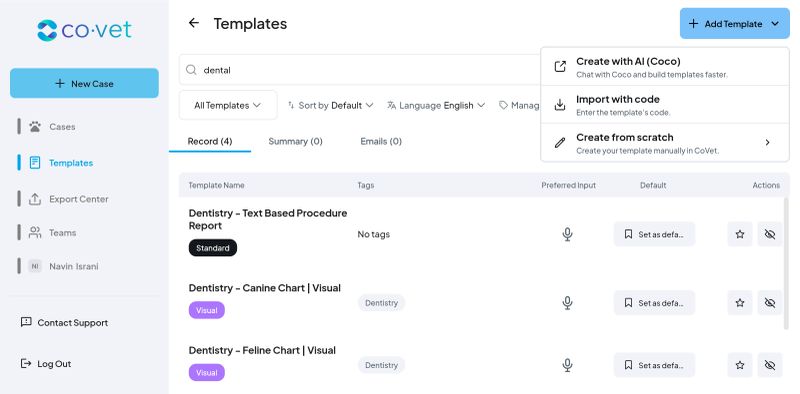
Automation can help reduce some of that repetitive documentation. Instead of starting with a blank dental examination form every time, CoVet provides customizable templates with structured fields for canine dental workflows. As you discuss findings during the oral examination or throughout the dental procedure, CoVet lets you record them. The information is then organized into a structured patient record, reducing the amount of manual documentation needed afterward.
You can also tailor the same template to match your practice, as we discussed in one of the above sections. If you don’t find a template applicable to your case but found a PDF version of it on the CoVet website, you can also import such a template using the template’s code.
If an existing template doesn't fit your workflow, Coco (CoVet's AI template assistant) can draft or adapt one using text, audio, or imported files and refine sections and save back to CoVet.
CoVet provides 95+ specialty templates covering GP, exotics, equine, dentistry, and referral summaries. The aim is to reduce time spent recreating information after the procedure while supporting more consistent documentation. This helps complete the canine dental chart while the details are still fresh and maintain a more reliable long-term patient record.
Frequently asked questions about canine dental chart templates
1. How do veterinary teams keep canine dental charts accurate when multiple technicians and veterinarians are involved in the same procedure?
Using a standardized canine dental chart helps every team member document findings in the same format using consistent tooth numbering and terminology. Recording findings as they are observed, rather than relying on memory later, also reduces omissions and errors. This helps make handoffs smoother and ensures everyone in the clinic works from the same patient record.
2. What findings are most commonly missed on canine dental charts, and how can clinics prevent those documentation gaps?
The most commonly missed findings include periodontal pocket depths, gingivitis, mobility grades, radiographic findings, and conditions below the gumline that aren't visible during a routine oral examination. Clinics can reduce these gaps by following a structured chart, completing periodontal probing for every tooth, and documenting radiograph findings alongside the clinical examination.
3. When should a canine dental chart be updated during the dental procedure instead of after the patient recovers?
Update the chart as findings are made throughout the dental procedure whenever possible. Recording observations in real time is more accurate than reconstructing the procedure later from memory. It also reduces end-of-day documentation and helps create a more complete patient record.
4. How can veterinary clinics standardize canine dental charting across routine cleanings, extractions, and advanced dental procedures without creating separate documentation workflows?
Start with one standardized canine dental chart and customize it by adding or removing sections based on the procedure being performed. For example, a routine cleaning may only require periodontal findings, while endodontic or surgical cases need radiographs and additional fields for advanced treatments. This approach makes the documentation process familiar while allowing the chart to support different workflows.
5. How do complete canine dental charts improve follow-up care and help veterinarians monitor periodontal disease over multiple visits?
A complete chart gives future veterinarians a clear baseline for comparing changes over time. Consistent records make it easier to monitor periodontal disease, identify new dental pathology, evaluate previous treatments, and adjust future care plans. They also improve communication between clinicians when different team members see the same patient.
6. How can real-time documentation reduce end-of-day charting and improve the quality of canine dental records during busy clinic schedules?
Real-time documentation captures findings while they're still fresh instead of relying on handwritten notes or memory after the procedure. This reduces duplicate data entry, helps prevent missed details, and keeps patient records more consistent. Tools like CoVet also organize those findings into structured clinical notes, reducing the administrative work required after each procedure.
About the Author
)
)
)