)
Maintenance of veterinary medical records is not a separate activity to patient care at a veterinary facility but a constant background process that runs in parallel. These records might seem like the most boring part of admin work, but they are the backbone of quality patient care.
If veterinarians are not careful about keeping them error-free, they can lead to:
reduction in quality of care when important patient and case history are missing, incomplete, or difficult to find.
Breakdowns in communication between staff and pet owners due to spotty documentation.
Increase in after-hours charting, staff burnout, and admin friction among the staff.
Increase in compliance and operational risk and legal liability as teams spend more time in admin work.
But patient records are only one part of the solution, the other part is standardizing those records into templates. Veterinary medical record templates provide that structure behind admin protocols and ensure all clinic staff always capture critical information without errors.
Before you implement technology, first you must standardize your processes for creation, review, and sharing of medical records in your clinic. Then, you can use tools like CoVet's veterinary medical record templates to reduce admin effort for your teams in following those workflows.
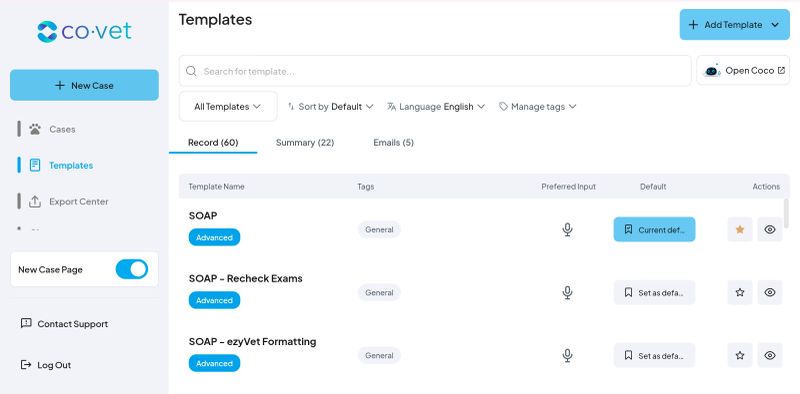
Looking for more specialized templates for veterinary forms?
Browse our complete library of veterinary documentation templates:
What is a veterinary medical record template and why do you need one?
A veterinary medical record template is a structured veterinary documentation framework. It captures, organizes, and standardizes clinical, admin, and legal information throughout a patient's care journey.
It acts as a predefined format that guides veterinary staff in complex and repetitive admin work. This admin work includes error-free maintenance of client information records, patient history, their entire in-clinic journey, & client communications.
A veterinary medical record goes far beyond just a patient history form
The term "veterinary medical record" works as an umbrella that covers many document types, including:
SOAP (Subjective, Objective, Assessment, and Plan) notes,
physical examination & hospitalization records,
progress notes, and patient history forms,
treatment sheets & discharge summaries,
surgery records, vaccination records, & dental charts,
diagnostic reports & laboratory results,
problem-oriented veterinary medical records (POVMRs).
Why standardization of veterinary medical record keeping matters
Standardized medical records and processes help veterinary clinics deliver highest-quality care to every patient and improve staff coordination. They also help ensure legal compliance with the state’s veterinary medical record laws.
Your staff having to rely on memory or individual habits can break even standardized processes. Veterinary medical record templates can help by turning these standardized processes into repeatable workflows.
Small documentation inefficiencies can compound throughout the day and the week. In the long term, they can cause communication issues, delayed workflows, and increased after-hours charting.
Veterinary medical record templates help reduce these inefficiencies in veterinary practice management by ensuring that everyone captures critical information always in the same way.
Legal compliance remains another major objective of veterinary medical records. Human healthcare providers have to follow a single federal law, HIPAA. But veterinary clinics must follow a patchwork of state-specific veterinary medical record laws. And non-compliance can lead to disciplinary action, malpractice liability, fines, or even loss of licensure.
Different types of veterinary medical record templates and where you may need them
Template type | Primary purpose | Related template |
Veterinary medical record template | Serves as a central patient record and brings together clinical history, exams, medications, and follow-up care. | This template: |
Physical exam template | Documents physical examination findings during wellness visits, sick appointments, and routine consultations. | |
Treatment sheet template | Tracks medications, treatments, monitoring activities, and nursing care during hospitalization. | This template: |
Surgery record template | Records anesthetic protocols, surgical procedures, intraoperative findings, complications, and recovery notes. | |
Dental chart template | Documents dental examinations, tooth-level findings, procedures performed, and treatment recommendations. | |
SOAP notes | Structures clinical encounters and progress notes using Subjective, Objective, Assessment, and Plan documentation. | |
Veterinary report template | Summarizes diagnoses, treatments, and outcomes for communication with clients, insurers, or external referrals. |
What to include in a veterinary medical record template
Efficiency and compliance will look different for each state and every practice. So the fields you include in the template will also be equally unique. The goal while creating your template is legal compliance with your state laws and quick and clear communication among your team.
All veterinary medical record templates will have a set of core sections that are common to all report subtypes.
Patient signalment
Accurate signalment is your first and most critical clinical diagnostic tool. Capturing the same detailed patient signalment information at every intake ensures no one in your clinic mistakes one animal for another. It also prevents medication errors and ensures the patient is safely identified at each stage in the clinic.
Species & breed: Use standardized dropdown menus rather than free-text fields. This ensures genetic and breed-specific health alerts automatically flag in the patient's record.
Age / date of birth: Calculate exact age dynamically from the date of birth to maintain exact medication dosage and age-appropriate care plans.
Sex & reproductive status: Clearly document male/female alongside spay, neuter, or intact status to diagnose and treat reproductive health risks.
Permanent identifiers: Always record unique identifiers like microchip numbers, tattoos, or rabies tag numbers as a mandatory second identifier before any procedure.
A patient history template can build on this foundation by placing historical patient records alongside current case details.
Case identification
Case identification links the patient to a specific visit and ties clinical notes and billing to the same visit. Capturing this data instantly tells you what the case is about, who handles it in the team, and how long it could take for the treatment to complete. It also maintains a clear record of all facts for legal disputes (useful if needed).
Encounter number / case ID: A unique, auto-generated number to separate each visit from others and the patient's own historical records.
Date & time of intake: Document the exact date and time of intake so you can give medication at the right intervals, and check on their progress.
Attending veterinarian & technician: Name the primary care team who will ensure clear internal communication and may be answerable in legal disputes.
Encounter type & status: Mark the visit type (e.g., Appointment, ER Drop-off, Surgery) for smooth clinic workflow and prioritize patients as per severity of their needs.
Exam findings and diagnostic results
This section structures physical exam findings and diagnoses so staff can decide the next steps of care according to progress over time.
Vital signs & triage metrics: Record core physiological data immediately. This sets a baseline for safe anesthesia administration, shock assessment, and to check the effectiveness of the treatment.
Physical examination (PE) by system: Document findings using a structured "Normal / Abnormal" format with mandatory description fields for abnormalities. This ensures a complete, well-rounded head-to-tail exam.
In-house diagnostic results: Log test results immediately to guide clinical treatment in real time.
Reference labs & imaging log: Note pending or final external diagnostic tests/procedures so all external data links directly back to this specific case.
Customize exam report based on the type of examination
Report name | Suggested fields |
Surgical Report | Include details necessary for safe anesthesia, surgical approaches used, and counts for material used. This ensures the surgeon follows every step of the checklist for patient safety before closing a case. |
Histopathology Report | Include specific biopsy site/type, gross appearance, and margin assessment status. These give pathologists essential diagnostic details and help track precise margins. |
Radiology Report | Include patient sedation status, specific views taken, and structural findings. These are required to check image quality and note objective observations from the report. |
Endoscopy Report | Include equipment details, the endoscopy procedure details, and log details about any tissue sampled during the procedure. These help check if the procedure was performed safely with the right device configurations, and record any biopsy details. |
Assessment, diagnosis, and treatment plan
This section documents a structured clinical treatment plan alongside each clear differential diagnosis (based on your diagnostic data). The entire veterinary care team can thus execute the treatment plan with total accuracy and stay on the same page during the treatment.
Clinical assessment & differentials: Synthesize the history and exam findings to list potential diagnoses in order of probability. This structures clinical diagnoses and guides next-step decisions if initial therapy fails.
Definitive diagnosis / problem list: Log the final confirmed diagnosis or maintain a list of active problems for complex cases to ensure that the team addresses all clinical abnormalities actively.
Immediate treatment orders (Rx): Document detailed inpatient orders explicitly, including the entire medication schedule with correct dosages in units (not just volumes).
Continuity of care & monitoring plan: Outline specifically what to monitor to direct the team about the treatment response.
Client communication and discharge summary
If discharge instructions are unclear or ambiguous, the owners may call back in panic after they leave the clinic. They may not follow the after-discharge care instructions carefully which may cause unintentional harm to the patient. This section prevents such situations by capturing client communication logs and provides owners with a structured, jargon-free care plan.
Take-home medications & administration instructions: List all take-home medications with clear, plain-language instructions. Always include the purpose of each drug and include instructions to modify dosage or eliminate a medication if possible in case the patient has adverse reactions.
At-home care & activity restrictions: Explicitly outline exercise limits in human-friendly language, any diet changes, instructions for wound care, or e-collar requirements.
Red flag symptoms & emergency protocols: Provide a specific list of warning signs that require immediate medical attention and include contact details for the preferred emergency clinic.
Follow-up schedule: Detail exactly when the patient needs to return to the clinic and for what purpose relative to the treatment or when a phone check-in would suffice.
Client communication log: Record a summary of the verbal discussions held with the owner, including informed consent updates, prognoses discussed, and confirmation that the owner understands the discharge instructions.
Adapting the template for your specific veterinary practice and different exam types
A rigid charting template fails because, for example, the data structure in the report for a mobile equine field exam will be different from a neighborhood small-animal surgery.
Customizing these frameworks for your specific patient record needs sets a clear standard for your team and keeps your clinic legally secure. Spend a few hours upfront to set this up so your staff doesn’t need to wade through useless fields, or spend after-hours on charting.
Adapting the veterinary medical records by practice type
Practice type | Sections to remove or simplify | Sections to add and suggested fields |
General practice / short-stay | Simplify the exam findings and diagnostic results by using a rapid checklist for routine visits. | Add a notable section for preventative health notes and to record vaccines due dates for rabies, DHPP, and parasite prevention. |
Emergency / critical care | Remove the client communication and discharge summary from the primary active chart; that is handled separately after stabilization. | Add a high-visibility triage and shock assessment panel at the very top with continuous pain scoring & fluid resuscitation logs. |
Additional treatment / specialty referral | Simplify the patient signalment section during intake based on what the referring veterinarian has added to/omitted from their signalment. | Add a referring veterinarian communications section to log updates you will send back to the primary clinic, along with advanced diagnostic logs. |
Equine / large animal | Remove standard small-animal vitals like temperature ranges meant for dogs/cats, and simplify the case identification for clinic-bound setups. | Add biosecurity levels, farm/stable location id, and specific horse tracking details like microchips, lip tattoos, or signalment diagrams/pictures. |
Adapting the veterinary medical records by exam type
Exam type | Sections to remove or simplify | Sections to add and suggested fields |
Surgical / advanced procedure report | Remove the general problem list and simplify the at-home care section into a single, standardized post-op protocol. | Track the anesthesia and vitals during surgery, note your approach and hardware, and count all materials and sponges. Document it all in this section. |
Histopathology report | Remove standard physical exam systems, live patient vitals, active differentials, and immediate treatment orders. | Record the biopsy site and type, track the sample identification numbers, describe the lesions, and note your microscopic findings and final margin status. |
Radiology (imaging) exam report | Simplify the client communication log and remove direct prescription fields from the reporting window. | Note the patient's sedation status, the exact X-ray views you took, the image quality grade, your structural findings, and the final radiologist impressions. . |
Patient referral summary | Compress lengthy raw objective data fields and remove internal clinic workflow or triage tracking codes. | State the main reason for referral, summarize the case timeline, list current medications, and give clear instructions to the receiving specialist. |
Necropsy report | Remove all live monitoring metrics, triage fields, immediate treatment orders, and take-home medications. | Note how you stored or handled the carcass, describe the external body condition, detail your gross organ findings, and state the preliminary cause of death. |
Common problems with veterinary medical record and treatment documentation and how to fix them
Attorneys, regulatory boards, and practice software experts view medical records through a single, strict lens: "If it is not in the record, it did not happen." In a busy clinic, your staff may be neglecting recordkeeping or they may be buried under high case volumes and charting work.
Here’s a list of veterinary medical record problems and how templates can fix them.
1. Incomplete patient files and weight-metric errors
Omitting basic tracking metrics like an up-to-date patient weight, explicit symptom timelines, or detailed treatment responses directly opens the door to misdiagnoses. When busy teams rely on memory to backfill charts at the end of a shift, missing updates for even basic metrics directly lead to dosing discrepancies and compliance risks. To prevent this, every clinical entry must be complete and updated in real time to ensure seamless continuity of care across different shifts.
How a template solves this: Pre-formatted, mandatory fields in a template for weight and automated age calculations ensure your team cannot skip these critical metrics before moving forward.
2. Delayed record updates and legal presumptions
Waiting until the end of a shift or the end of the week to write up clinical notes heavily compromises chart integrity. Legally, regulatory boards start with the presumption that records made immediately following a procedure are the most accurate and truthful. When hours or days pass before an entry is made, critical details can be forgotten or may not match patient condition on those dates. That leaves your treatment choices open to interpretation and vulnerable to legal disputes.
How a template solves this: Starting case documentation with a standardized template instead of with a blank document drastically reduces charting time down to a few minutes. This allows staff to log entries immediately after a procedure or clear out the end-of-day documentation debt in minimal time.
3. Illegible handwriting and chaotic digital formatting
Handwritten charts that are impossible to decode or digital entries that lack a clean layout cause dangerous misinterpretations. If a relief veterinarian or an assistant cannot instantly scan and understand a patient's historical chart, they can easily miss critical warnings and unknowingly cause medication errors or serious breakdowns in patient care.
How a template solves this: Because a single template is used instead of letting every veterinarian use their own record format, the sense-making of patient notes becomes much faster because everyone knows what to expect in the document and where. Besides, digital records with spellcheck eliminate handwriting errors or typos in medication names.
4. Cryptic shorthand and non-standardized notes
Using highly localized terminology, doctor/region-specific abbreviations, or messy free-text shorthand creates dangerous communication gaps among the pet’s care team.
For example, a doctor writing a quick note like "PE: LE, M" might understand it means a "limited exam" was performed while the pet was "muzzled." However, a technician reading that chart later might miss the warning if they don’t understand M means muzzled, which could cause an avoidable staff injury.
If the staff uses shorthand, they must all be aware of it from their definition in your office policy. And these shorthand terms must also sync up with terms that are naturally accepted in your state/country.
How a template solves this: Digital veterinary record templates replace free-text fields with standard, pre-defined dropdown menus which removes guesswork and keeps your team's internal communication uniform.
5. Vulnerable backups, weak data security, and lack of audit trails
Relying on local servers without automated off-site backups, letting staff share generic logins, or failing to lock edited charts creates huge compliance issues in the long run. If a medical record can be altered after the fact without a transparent, date-stamped audit trail, its credibility vanishes during a board investigation. Furthermore, a ransomware attack or physical damage can permanently erase your histories, crippling your business operations.
How a template solves this: Modern template software integrates directly with cloud systems that automatically save progress, restrict user permissions, and generate locked, date-stamped compliance logs.
6. Missing or unlinked client consent records
Failing to clearly document a client's informed consent (or lack there of) is a massive administrative vulnerability. Simply typing a brief note like "declined blood work" offers minimal legal protection. To establish true informed consent, the owner must read and sign appropriate consent forms. Documenting the unavailable consent (ideally backed by a signed consent waiver linked directly to that specific encounter) adds explicit proof that the client understood the clinical risks of refusing care.
How a template solves this: Digital veterinary record templates have clickable sections for client consent and declined care baked straight into the workflow. This removes friction during intake and instantly prompts the care provider to document the risks discussed and quickly get a digital signature on a waiver form.
7. Fragmented anesthesia and surgical tracking
From a legal standpoint, irregular or selective charting means your records are likely inadmissible to prove a standard of care was met. If a clinic's policy is to only log complications rather than continuous vitals, a legal subpoena of those files will make it look as though every single surgery performed at your practice resulted in a catastrophic failure. Or the record might not show the detailed readings that led to a failure which your team noted but didn’t add to the record.
How a template solves this: Dedicated surgical and anesthesia blocks in surgical record templates force the continuous logging of vitals and checklist requirements. This creates a complete, defensive record of standard care.
Automating your veterinary medical record template
Despite having a well-structured template for all your reports your veterinary medical records may not be flawless. This is because filling out every field manually still takes time, and often forces your staff to type out notes from memory or fragmented snippets at the end of a long shift.
This is a gap that automation technology can solve by squeezing the template customization time by a big margin. It can automate documentation of the patient’s entire journey at the vet, not just its treatment plan. Integrating an AI-driven platform with your PMS eliminates friction from your workflow.
Modern clinical tools like CoVet bridge this gap by recording spoken clinical findings during or after an encounter and structuring them directly into organized, print-ready files. Instead of typing or toggling between screens to copy over vitals and lab values, you simply talk through the exam, surgery, or case summary. The system populates the matching template fields automatically.
Ambient audio capture lets you dictate notes hands-free between back-to-back appointments, switching from an exotic avian checklist to a routine canine SOAP note without touching a keyboard.
CoVet features built-in, customizable templates across clinical, surgical, imaging, pathology, and referral report types, and all are designed by an in-house medical team to match real-world veterinary needs.
CoVet’s AI template builder, CoCo, makes it straightforward to adapt field labels, add practice-specific sections, or create entirely new formats for highly specialized procedures. Once a record is finished, it syncs instantly to your practice management software via direct integrations or a Chrome extension. This locks high-quality records into the patient's file without a single manual transfer or copy-paste step.
Practice-specific automation benefits
General practice: Speeds up high-volume days by instantly generating clean SOAP notes, logging recheck exams, and formatting routine preventative care records from background room audio.
Specialty: Streamlines complex workflows by building referral intake summaries from historic PDF uploads, auto-aggregating diagnostic panels, and drafting clear updates for referring veterinarians.
Emergency: Seamlessly captures the story as it unfolds in frantic environments, keeping case-wise histories and treatment logs together across changing priorities and multiple open cases.
Equine: Moves seamlessly from the clinic to muddy mobile fields with ambulatory veterinarians allowing them to dictate structured, species-specific notes on-site without needing a keyboard or a computer screen.
Exotics: Adapts flawlessly to unique anatomical differences and species-specific baselines, structuring custom fields for avian, reptilian, and small mammal patients without cluttering your standard charts.
Frequently asked questions about veterinary medical record templates
1. What are the most common veterinary recordkeeping mistakes that lead to compliance issues?
The most common veterinary recordkeeping mistakes include delayed chart updates, missing client consent forms, incomplete patient data like outdated weights, and non-standardized clinical shorthand. Because clinical shorthand is often not standardized and regulatory boards operate on the principle that "if it is not in the record, it did not happen," these documentation gaps create massive admin and legal vulnerabilities during clinic audits.
2. How do veterinary clinics standardize medical records across multiple veterinarians and technicians?
Veterinary clinics standardize medical records by using structured veterinary medical record templates that turn clinical documentation into repeatable workflows. These predefined frameworks replace individual staff habits and guide all veterinarians and technicians to record history, diagnostics, and treatments in an identical format. This consistent layout when implemented using unified digital templates reduces charting friction and eliminates shift-change communication gaps. It also enables instant insights, critical warnings, or vital trends from a historical chart.
3. What is the difference between a SOAP note template and a full veterinary medical record template?
A SOAP note is a specific type of clinical documentation used to structure an individual encounter, whereas a full veterinary medical record is a comprehensive repository tracking a patient's lifelong care journey.
Record component | Scope and purpose | Included elements |
SOAP notes | Structures a single clinical encounter. | Subjective history, objective vitals, assessment/differential diagnoses, and treatment plan. |
Veterinary medical record | Lifelong patient tracking and regulatory compliance. | Signalment, case IDs, dental charts, surgery logs, billing, and client communication logs. |
A good SOAP note automation software goes beyond automating the treatment plan for an individual encounter. It provides the ability to auto-generate your SOAP notes and automatically integrates them into your admin workflows and your practice management software.
4. How do emergency veterinary hospitals handle medical record documentation during high-volume caseloads?
Emergency veterinary hospitals manage high-volume caseloads with the help of adaptive electronic medical record frameworks that prioritize rapid clinical stabilization over standard admin updates.
To handle rapid case shifts under tight time constraints, emergency hospitals add high-visibility triage and shock assessment panels directly to the top of the patient's record. This allows staff to capture changing vital trends, continuous pain scores, and fluid resuscitation logs in real time as the critical story unfolds across multiple open cases. To save charting time, emergency veterinary hospitals strip away traditional client communication and discharge summaries from the active medical record, which are only captured post stabilization.
5. Can veterinary medical record templates be customized for different practice types like equine, dental, or specialty care?
Yes, veterinary medical record templates can be fully customized by removing irrelevant small-animal metrics and adding practice-specific tracking fields which saves hours of admin time as staff don’t have to wade through useless entry fields during complex workflows.
Practices adapt their digital documentation systems using distinct field configurations based on their medical focus:
Equine care: Removes standard small-animal vitals to focus on farm locations, biosecurity levels, and horse tracking details like lip tattoos or signalment diagrams.
Specialty and referral: Simplifies initial intake onboarding to add advanced diagnostic panels, historic PDF uploads, and dedicated tracking loops for referring veterinarians.
Dental care: Utilizes dedicated dental chart templates to document tooth-level structural findings, local procedures, and long-term treatment recommendations.
6. What should veterinary practices include in medical records to reduce malpractice or licensing risks?
To protect against licensing risks and malpractice liability, veterinary practices must include signed consent waivers linked directly to encounters, up-to-date patient weights, and unalterable, date-stamped audit trails.
Medical records must contain four non-negotiable compliance items:
Informed consent tracking
Accurate patient signalment (including mandatory double-identifiers and exact weight metrics to justify pharmaceutical dosing choices).
Continuous surgical vital logs (that go beyond adverse events and log complete anesthesia tracking sheets and checklist requirements).
Standardized vocabulary (by using predefined dropdown menus instead of localized, cryptic shorthand).
Because state regulatory boards operate on the strict legal principle that "if it is not in the record, it did not happen," omission of these defensive proofs destroys record credibility during a board investigation.
About the Author
)
)
)