)
)
A veterinary shift handoff passes each patient's status, plan and open tasks to the incoming team. CoVet is an AI clinical copilot built for veterinary teams. Its Rounds handoff reports take the open cases you select and draft one handoff report, with an I-PASS card per patient, for you to check, edit and approve.
CoVet is an AI clinical copilot built for veterinary teams. When you record a consultation, CoVet turns the conversation into a structured clinical record, organising the relevant history, examination findings, assessment, and treatment plan into your preferred format. Those same records feed your shift handover. It's 7 p.m., there are nine patients in the ward, and the overnight vet is hanging up their coat. Here's how to structure a veterinary shift handoff, what the evidence says, and how to draft one from the cases your team already wrote.
Key takeaways
|
What goes into a veterinary shift handoff?
I-PASS is a structure for spoken and written handoffs, built in human hospitals and now taught to veterinary nurses and technicians. It was published as a mnemonic for verbal handoffs by Starmer and colleagues in Pediatrics in February 2012, and the definitions below follow AHRQ's TeamSTEPPS I-PASS tool (page last reviewed July 2023). Each letter is one part of a veterinary shift handoff, in the order you say it.
I-PASS element | What it covers | A veterinary example |
|---|---|---|
Illness severity | Stable, "watcher" or unstable | "Bella is a Watcher. She vomited again at 5 p.m." |
Patient summary | Why the patient is here, the course so far, the current plan | Three nights in for pancreatitis, eating small amounts since this morning |
Action list | The to-do list, with times and an owner for each task | Recheck PCV at 10 p.m. Overnight tech owns it. |
Situation awareness and contingency planning | What's going on now, and what to do if things change | If she vomits again, start the second antiemetic and call the owner |
Synthesis by receiver | The incoming vet sums up what they heard, asks questions and restates the actions | "So PCV at 10, antiemetic if she vomits, and the owner wants a call either way." |
SBAR (situation, background, assessment, recommendation) is the other structure you'll hear about. Today's Veterinary Nurse covers both in its Fall 2026 article on strengthening rounds by Melissa Evans, LVT, CVT, VTS (ECC).
Does a structured handoff make a difference? What the evidence says
The strongest evidence comes from human medicine. In the New England Journal of Medicine on 6 November 2014, Starmer and colleagues reported on an I-PASS program across nine hospitals and 10,740 admissions. Medical errors fell 23%, from 24.5 to 18.8 per 100 admissions. Preventable adverse events fell 30%, from 4.7 to 3.3. Spoken handoffs took 2.4 minutes per patient before and 2.5 after. The program was a bundle for pediatric residents: the mnemonic, training, faculty observation and a campaign to keep it going.
Veterinary studies point at the same weak spot, communication, though none tests a handoff tool:
In 100 settled negligence claims involving dogs, communication problems contributed to 80%, and problems inside the veterinary team stood out (Russell et al., Veterinary Record, February 2022).
Across 560 incident reports from three hospitals, drug errors came first and communication failures second. 15% of incidents harmed the patient (Wallis et al., Frontiers in Veterinary Science, February 2019).
In two UK practices, communication errors were the most frequent type, and part-time rotas meant frequent handovers (Kinnison et al., Veterinary Record, November 2015).
A 2025 case report describes how missing information across anesthesia handoffs contributed to a dog's death. The hospital wrote a handoff checklist afterwards (Rupp and Henze, Veterinary Anaesthesia and Analgesia).
In a survey of 247 specialty and emergency vets, handoff was among the most-used structured tools, and frequent use went with more open team communication (Stone et al., JVECC, July to August 2026). That's an association from a survey.
What we know | What we don't |
|---|---|
Communication problems show up again and again in veterinary errors and claims | Whether I-PASS changes outcomes for veterinary patients |
A structured handoff program cut errors in human hospitals without slowing handoffs | Whether an AI-drafted handoff report helps |
Rounds handoff reports use the I-PASS structure. Nobody has studied them.
Why is the ER shift change the hardest handoff?
An ER vet handoff carries more than any other. The patient who has been in for three nights has notes from six people across several shifts. The cat who came in at 4 p.m. arrived before anyone was assigned to the case. The owner who rang at 5 p.m. agreed to an estimate with a ceiling, and the next vet inherits that conversation along with the fluids. Continuity of care comes down to whether those details make it across the desk.
Rounds handoff reports are built for the teams who do this every day:
Emergency and urgent care teams changing shift with a full ward
Specialty and referral hospitals receiving and returning cases
Multi-doctor practices where part-time rotas mean several handovers a week
Vet techs and nurses running treatments overnight
How it works in CoVet: a Rounds handoff report from your open cases
As of October 2026, per CoVet's help center, here's how to draft a veterinary shift handoff from the cases you already have.
Keep each patient's stay in one case. Multi-day cases hold every note, recording and document for the whole stay, across shifts, and active ones sit under Ongoing (Product Updates, February 2026). If you're new to cases, start with one case for the whole visit.
Open Rounds summaries. On the Cases page, select the Rounds summaries card, next to Ongoing and Unassigned.
Pick the cases you're handing over. The panel opens on the last 24 hours. Quick-select All, Ongoing, the last 12 hours or a team, filter by visibility, or search. Unassigned cases your team can see are eligible too, and anyone on the team can claim one (Product Updates, February 2026).
Select Generate Rounds Summary. Each case moves from Pending to Generating to Done. You can leave the page and come back. Larger selections take longer, and CoVet tells you when one will take a few minutes.
Read the report. You get one card per patient, Unstable first. Re-sort by Stable first, A to Z, newest or oldest, case owner or team, or drag cards into your own order. CoVet remembers your choice for next time.
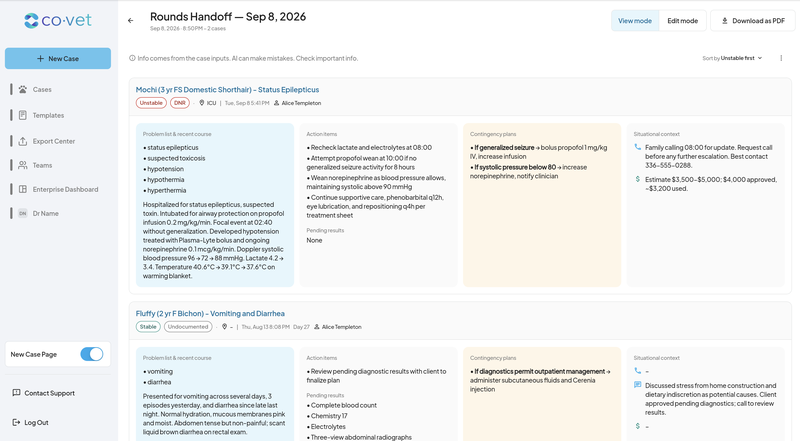
Edit what needs fixing. Switch to Edit to correct or add to a card. Your changes apply when you switch back to View. Reset changes undoes the edits on that one card and leaves the others alone.
Download the PDF. The PDF matches the screen and keeps each card on one page. To find an earlier round, open Previous Rounds in the selection panel, or Rounds history in a case's Case Content menu.
What does each I-PASS card show, and what stays with the incoming vet?
Every card in a veterinary handoff report follows the same layout. The card drafts the first four parts of I-PASS. The fifth part belongs to the people in the room.
I-PASS element | On the CoVet card | Your job |
|---|---|---|
Illness severity | Stable, Watcher or Unstable, plus code status (CPR or DNR) | Confirm both. |
Patient summary | Patient header (name and chief complaint, location, day and time, owner, visibility), problem list and recent course | Check it against the case |
Action list | Action items, including pending results | Check who owns each task and when it's due |
Situation awareness and contingency planning | Contingency plans, plus situational context: phone contact, client communication and financial context | Add what you know that never made it into the notes |
Synthesis by receiver | Left to the people at shift change | The incoming vet reads the plan back and asks questions |
An example: the 7 p.m. handoff at an emergency hospital
This is an example scene. It describes no real clinic, patient or customer.
Nine inpatients. Bella, a spaniel, is on her third night with pancreatitis, all in one multi-day case. Mango, a blocked cat, came in as unassigned at 4 p.m. while the day vet was in surgery. Duke is a post-op GDV whose owner asked for DNR and set a ceiling on the estimate.
At 6:45 the day vet opens Rounds summaries, taps Ongoing, adds Mango, and generates. The Unstable cards come up first, so she reads Duke's card twice. His contingency plan says to call the owner if his heart rate climbs, but leaves out the DNR conversation, so she adds it. Mango's card lists a pending potassium. She downloads the PDF and walks the overnight vet through it, card by card. He reads back the action list: potassium at 9, call Duke's owner if anything changes, Bella's PCV at 10. Then he asks one question about Mango's urinary catheter, and they go and look at it together.
What should you check before you hand over an AI-drafted handoff?
Every Rounds handoff report carries its own reminder: the content comes from the information in the selected cases, AI can make mistakes, and important information should be checked. You approve the handoff before it goes anywhere. Five checks before you hand over:
Severity and code status. Does the tag match the patient in front of you, and is CPR or DNR right?
Medications and doses. Check each one against the case.
Pending results. Is every outstanding lab or image named, with who's chasing it?
Contingency plans. Would you do what the card says if the patient changes?
Client contact and money. Who called the owner last, what did they agree, and what's the estimate?
For more on reviewing AI drafts, see how to check an AI-drafted record and how CoVet keeps the final record in your hands.
Who can use Rounds handoff reports?
As of October 2026, per CoVet's help center, Rounds handoff reports are available to anyone who can open the Cases page. That includes Support accounts and the Essentials, Unlimited and Enterprise plans. The report needs an internet connection, and the Rounds summaries card is grayed out when you're offline. Access to a round reaches further than access to its source cases, so some people who can read a round can't open every case behind it. Our security page covers how CoVet handles access and data.
Frequently asked questions
Can AI write a veterinary shift handoff?
Yes, as a draft for your review. CoVet's Rounds handoff reports draft one report from the cases you select, with an I-PASS card per patient and a reminder that AI can make mistakes. You check and edit each card. As of October 2026, we found no other veterinary AI scribe that builds one handoff report from many existing cases.
What is I-PASS in veterinary medicine?
I-PASS is a five-part handoff structure from human hospitals that some veterinary emergency, critical care and specialty teams use. The letters stand for illness severity, patient summary, action list, situation awareness and contingency planning, and synthesis by receiver, as defined in AHRQ's TeamSTEPPS tool.
How do ER vets hand over patients at shift change?
Face to face where you can, backed by a written record that stands on its own. The Veterinary Practitioners Registration Board of Victoria's June 2019 guidance on case handover asks for a clinical record that lets the next rostered vet carry on the animal's care, including what was discussed with the client.
Does the handoff report work offline?
No. Rounds handoff reports need an internet connection, and the Rounds summaries card is grayed out while you're offline. CoVet records consults offline and uploads them when you reconnect, which is a separate feature.
Is a Rounds handoff report the same as CoVet's Rounds newsletter?
No. Rounds handoff reports are a feature on the Cases page in CoVet that drafts a shift handoff from the cases you select. Rounds at rounds.co.vet is CoVet's newsletter for customers. They share a name and nothing else, so search for "Rounds handoff reports" when you want the feature.
Can I still use a paper rounds sheet?
Yes. Paper works at the cage side, where a screen gets in the way. If you want a printed format, start with our printable patient rounds template. It covers interval events, vitals, medications and the plan for each hospitalized patient.
Does the report replace the verbal handover?
No. Keep talking. The report drafts the first four parts of I-PASS, and the fifth, synthesis by receiver, happens between two people. The incoming vet reads back the plan, asks questions and points out anything that looks off.
Hand over and head home
The best shift change is the one where you walk out the door with a clear head, and your colleague walks in already knowing who to look at first. Rounds handoff reports draft the cards from the work your team did all day, and you make them right. See what an AI clinical copilot does for veterinary teams, or try it on your next shift.
About the Author

The CoVet Team
The CoVet team brings together veterinary professionals, technologists, and industry experts working to make clinical documentation easier and more sustainable.
)
)
)