)
)
Most veterinary software solves a real problem. The overload starts when each tool needs the same appointment described again, in its own format, at its own moment. The work between those tools becomes a second job stacked on top of clinical care.
Key Takeaways
The biggest cost often sits between tools, not inside them.
Most software stacks grew over time. Each tool solved a real problem, but few replaced anything.
Re-entry adds up fast. One appointment may be rewritten three or four times for different readers.
In CoVet's pilot with 11 VMG practices, 89% of participants reported some level of burnout before the pilot. Average end-of-day mental load was 3.5 out of 5.
Reducing the number of times information has to be captured can take more weight off than simply reducing the number of tools.
Start with where the load actually lands
The people drowning in their software stack are the same people running anaesthetic protocols, triaging a full waiting room, and telling an owner their dog has lymphoma, all before lunch.
Capability is not the issue.
The load builds because information keeps moving between systems, formats, and people. Here are seven common places that work piles up.
1. The re-entry tax
One appointment becomes a SOAP note. Then a discharge summary for the owner. Then a client message or email. Then an abbreviated line on the invoice, and maybe a reminder note.
The clinical facts are mostly the same. The format, reader, and level of detail change.
No single rewrite feels unreasonable. The problem is the accumulation.
Four descriptions of one appointment across twenty appointments can mean dozens of separate acts of writing in a day where you are also practising medicine.
2. Anything that needs your hands during a consult
Every tool that asks for attention during an appointment competes with the animal and owner in front of you.
The cost is not only the seconds spent typing. It is having to pick up the clinical thread again afterwards.
Our guide to veterinary client communication looks more closely at what happens in the consult room. A keyboard between you and an owner can change how the conversation feels and what gets shared.
3. Notifications with no ranking
Client messages. Refill requests. Lab results. Internal notes. Review responses. Failed reminders.
They arrive through separate channels with separate badges, often without any shared sense of priority.
A creatinine result that changes today's treatment plan can land with the same visual weight as a request to move a nail trim to Thursday.
So the team ends up triaging the software as well as the clinical work.
4. Unfinished notes get more expensive by the hour
An open note is not a fixed item on a list.
The longer it sits, the more work it takes to close. Details fade. You stop remembering and start reconstructing.
Ten unfinished notes can feel much heavier than ten times one unfinished note because they tend to land at the end of the day, when there is less energy left to deal with them.
If a backlog has already built up, why veterinary notes fall behind and how to catch up covers the recovery side.
5. Software built around the record, not the person keeping it
Veterinary systems have an important job: produce a complete, defensible, retrievable medical record.
That goal matters.
But producing a complete record and being easy to operate at 4:40 on a Friday with two walk-ins waiting are different design problems.
When the workflow around the record is cumbersome, the person at the keyboard absorbs the cost.
6. Tools get added. Tools rarely leave.
Ask a practice to list its software stack and the answer is usually longer than expected.
Practice management. Client communications. Reminders. Payments. Lab portals. Imaging. Telemedicine. Spreadsheets that became permanent by accident.
Most of those tools arrived because something needed fixing.
The problem is that new software often gets added without removing an old step. Over time, the stack grows while the work between systems grows with it.
7. The work follows you home
A surgery ends. A consult ends. A shift ends.
Documentation becomes something you are still behind on.
Software that follows you onto your phone can extend the reach of the work without creating more capacity to do it.
That is how “I can finish my notes at home” becomes “I finish my notes at home.”
Tool sprawl or short-staffing?
They can feel very similar from inside the practice, but the response is different.
Signal | Tool sprawl | Short-staffed |
|---|---|---|
Where the day overruns | After the last appointment, on admin | Throughout the day, on clinical work |
First thing to get dropped | Discharge summaries, follow-up calls, note detail | Appointment length, breaks, lunch |
How the team describes it | “I never get out on time because of notes” | “There are not enough of us for this caseload” |
Effect of a quiet day | The team catches up | There is still very little margin |
Effect of adding another tool | Brief improvement, then more complexity | Little changes |
If the problem is staffing, software cannot create another pair of clinical hands.
If the problem is repeated admin between tools, changing how information moves through the stack can make a noticeable difference.
What actually takes the weight off
Cut capture points, not tools.
The goal is to describe the appointment properly once, then reuse that information downstream instead of asking someone to enter it again.
Derive the documents that can be derived.
A discharge summary, client message, and referral letter often contain the same clinical facts written for different readers. That is a formatting and translation problem, not three separate documentation tasks.
Keep the system of record you already have.
CoVet works alongside existing practice management systems. The clinical note can be created in CoVet and sent back to the PMS, rather than asking teams to maintain the same information in two places.
That is what CoVet's PMS integrations are designed to support.
Protect the consult room first.
Reducing software attention during the appointment gives clinicians more room to listen, think, examine, and talk to the owner.
Measure the end of the day.
Do not only measure how long one note takes.
Look at what time people leave and how much mental energy they have left when they do.
In the VMG pilot, average end-of-day mental load fell from 3.5 out of 5 to 2.1. The share of participants who said they never felt admin-related burnout rose from 11% to 45%.
What the time is for
It is easy to reduce this conversation to a number of hours.
But hours are abstract.
What teams tend to notice is more specific: eating lunch sitting down. Getting through a consult without turning away from the owner to type. Going for a walk before it gets dark. Answering the phone when a friend rings. Having enough left at 7pm to be decent company.
That is the outcome.
The hours are simply how you get there.
Frequently asked questions
Why do veterinary teams feel overwhelmed by their software?
Because the same appointment often has to be entered, rewritten, and reformatted several times across different tools. The load comes from repeated handoffs and re-entry as much as from the software itself.
Is the problem having too many veterinary software tools?
Not necessarily. A practice can use many tools comfortably when information moves between them. Three disconnected tools can create more work than six connected ones.
A better question is how many times the team has to re-enter the same information.
Do we need to replace our practice management system?
No. Replacing a PMS is a large operational project. If the main problem is how clinical information gets captured and moved, changing that part of the workflow is a much smaller intervention.
How do we tell software overwhelm from being short-staffed?
Look at where the day overruns.
If the overrun happens mainly after appointments and is made up of notes, messages, and follow-up admin, workflow is likely part of the problem.
If the pressure runs through the whole day and is driven by the amount of clinical work, staffing is more likely to be the constraint.
How long before the load actually drops?
The mechanical part can change quickly once fewer steps are required.
Habits often take longer.
Teams may continue saving notes for later even after the reason for doing so has disappeared. The workflow can change before the habit does.
About the Author
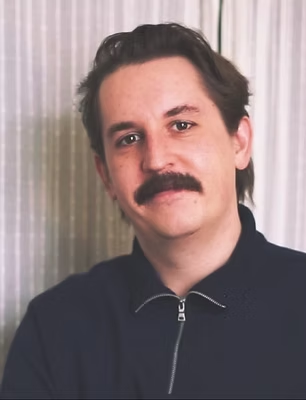
Iain MacNeil
Iain MacNeil is the Content Manager at CoVet. He's the one behind most of what you read here (the copy, the guides, the launch emails, the brand voice) and he's spent the last ten-plus years turning complicated things into stuff people actually want to read. He studied Creative Writing at Concordia, lives in Montreal, and can still land a kickflip despite being in his mid-30s.
)
)
)